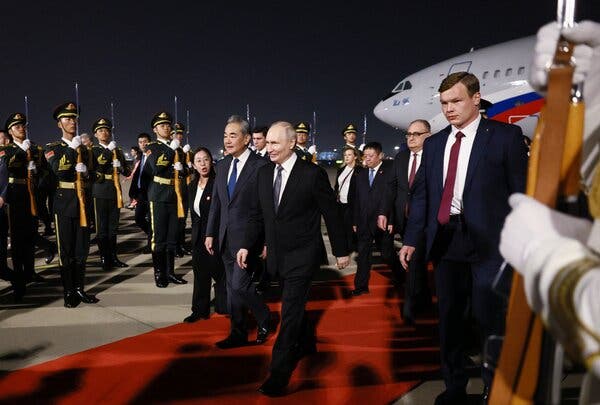
President Vladimir V. Putin of Russia visited Beijing on Tuesday against a backdrop of international challenges. The Russian leader’s visit coincides with widespread disruptions in energy supplies in the Persian Gulf, prompting Russia to strengthen its energy relationship with China.
Putin’s arrival in China occurs during a period of conflict for Russia. The Russian military is struggling in Ukraine, and Moscow has become increasingly susceptible to Ukrainian drone strikes. Simultaneously, Russia’s economy is under significant pressure, with increasing domestic dissatisfaction due to the ongoing military endeavors.
The imbalance in economic relations between Russia and China persists. According to Aleksandr Gabuev, director of the Carnegie Russia Eurasia Center in Berlin, China holds substantial influence and can determine the terms of their economic cooperation.
Despite this, Russia aims to establish itself beyond a subservient role to China. Russia’s substantial nuclear capabilities could enhance its alliance in potential global conflicts, including those concerning Taiwan. Additionally, Russia’s actions in Ukraine have cast it as a leader within a non-Western world order, a position endorsed by Beijing.
The conflict involving the United States and Israel against Iran has also created new geopolitical opportunities. This scenario potentially benefits Moscow as it seeks to navigate these complex relationships.
As tensions escalate globally, Russia’s engagement with China highlights the intricate dynamics at play. Moscow seeks to assert its position amidst ongoing global disruptions and power shifts.
 Pamela Hicks: Cousin, Bridesmaid, and Witness to History
  Latin American Deportees in Congo: Return to Home Countries Amid Challenges
  Controversy Surrounds Stabbing Incident of British Student
  Royal Cottages and Controversies: Financial and Legal Revelations
  Oak Lawn Librarian Supports Library Projects in Zimbabwe
  World Cup Anticipation: US Men’s National Team and Norway’s Viking-Themed Campaign