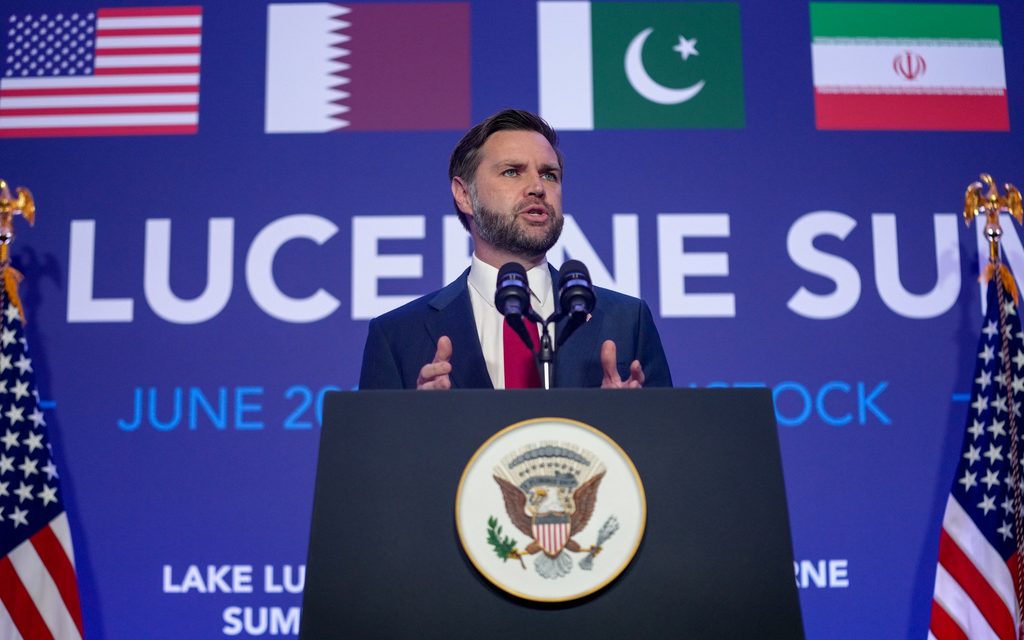
Vice President JD Vance spoke to the media following high-level talks between the U.S. and Iran at the Bürgenstock Resort in Obbuergen, near Lucerne, Switzerland on June 22, 2026. The discussions resulted in the signing of the Islamabad memorandum. A key term of this agreement involves the release of $24 billion in frozen Iranian assets upon finalization of the deal.
President Trump has clarified that these assets will be released only after a comprehensive agreement is reached. The ongoing debate focuses on the timing and conditions for the release of these funds. However, there is an underlying question regarding the ownership of these assets and their rightful utilization.
Approximately $100 billion in Iranian assets remain frozen abroad. These are not merely funds for the ruling elite; they embody the collective product of the nation’s oil, commerce, and labor. International law recognizes the Islamic Republic as a sovereign entity. Yet, the regime’s actions, including domestic terror and regional destabilization, suggest that they misuse the national patrimony.
The United States has taken steps to prevent misuse of assets by similar regimes. For instance, when Afghanistan’s government collapsed in 2021, the U.S. froze around $7 billion in central bank reserves. Instead of transferring these assets to the Taliban, Washington established the Fund for the Afghan People, insulating $3.5 billion for the public.
In Venezuela, a similar mechanism protected over $3 billion from the Maduro regime. The International Emergency Economic Powers Act provides statutory authority for these actions. This law permits the preservation of assets to benefit the population rather than illegitimate governments.
With Iranian assets belonging to the population, policymakers are challenged to decide how best to serve them. Digital connectivity is vital, as the Iranian regime relies on information suppression through internet blackouts to maintain control. Tehran imposes severe penalties, including capital punishment, for unauthorized connectivity via services like Starlink.
Direct-to-cell satellite services may offer a solution by enabling mobile phones to connect directly without additional hardware. Although the Pentagon evaluated this option for Iran, high operational costs stalled progress. A trust fund similar to those for Afghanistan and Venezuela could bridge the funding gap.
U.S. policy has historically prioritized internet access for Iranians. The Office of Foreign Assets Control has established communication authorizations supporting Iranians in overcoming state censorship and surveillance. Expanding connectivity requires political will and sufficient capital.
An initiative named the Iranian People’s Connectivity or Internet Freedom Fund could be established, drawing from Iran’s frozen assets. Similar to predecessors in Afghanistan and Venezuela, this fund would ensure independence and stringent financial controls.
This strategic decision involves Washington choosing to return assets to the Iranian regime or support millions of Iranians opposed to the government. The latter path aligns with American interests and empowers rightful owners of the national patrimony.
A connected Iran poses a significant threat to the regime’s control. By investing in connectivity, Washington can hasten a transition without direct negotiation. This approach promises a future where Iranians are free from state-imposed silence and oppression.
Dr. Aidin Panahi is an energy expert affiliated with the Iran Prosperity Project. Dr. Saeed Ghasseminejad is a senior fellow at the National Union for Democracy in Iran and director of the Iran Prosperity Project.
 Iran’s World Cup Team Faces Challenges Amid Policy Changes
  Bahrain Imposes New Restrictions on Shiite Religious Observance
  Taiwan’s Demographic Challenge: Pets Outnumber Children Amid Falling Birthrates
  Historical Echoes: U.S. Strategies Against Maritime Threats
  Ebola Case Confirmed in France Amid Congo Outbreak
  Ukraine’s Targeted Strikes in Crimea Escalate Tensions