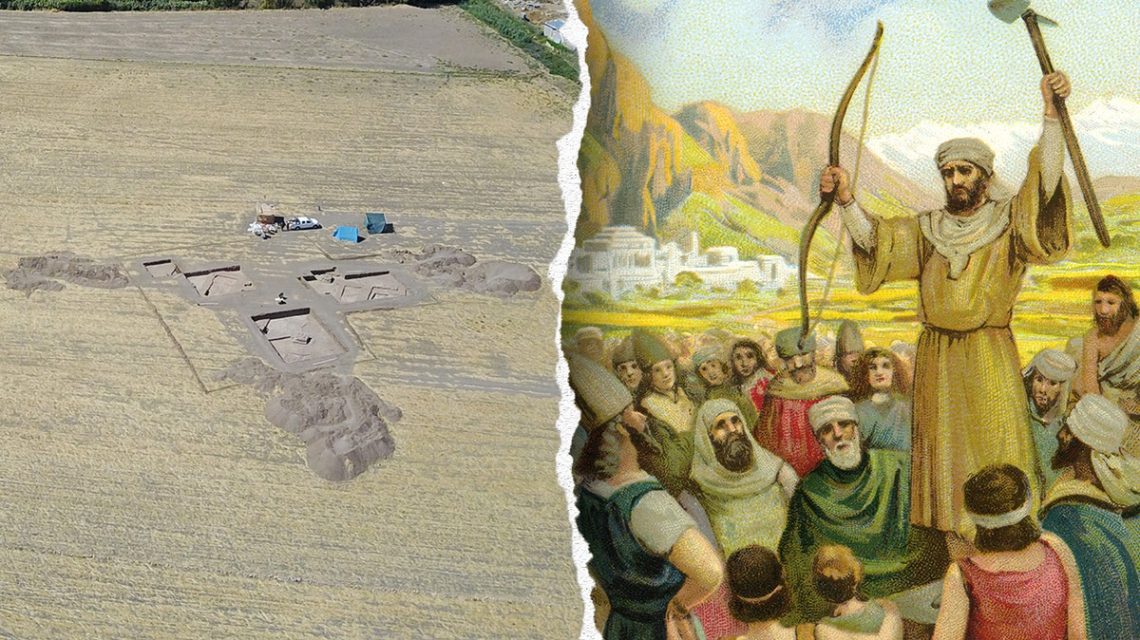
Recent archaeological discoveries in Iraq have uncovered signs that Christians coexisted with a previously lesser-known religion, Zoroastrianism. This was announced by Goethe University Frankfurt in Germany in December, following excavations that began in late summer 2025. These explorations centered on a complex at the Gird-î Kazhaw site in Iraq’s Kurdistan region, believed to have been constructed around 500 A.D.
Insights into the Architectural Findings
The archaeologists were initially uncertain about the building’s purpose until they discovered five square pillars, indicating it might have served as a church. Geophysical investigations further revealed the presence of more underground walls, suggesting that this ‘church’ could be part of a larger monastic structure. This idea gained traction with additional discoveries, including stone pillars that pointed to the existence of a possible three-nave structure, alongside artifacts from an early Christian meeting place.
One noteworthy find was pottery adorned with a Maltese cross, reinforcing the site’s connection to early Christian worship.
Historical Context of Coexisting Religions
The site’s proximity to a nearby Sasanian fortification offers significant historical context, indicating that Christians and Zoroastrians likely lived side by side. The Sasanian Empire, which existed from about 224 A.D. to 651 A.D., had Zoroastrianism as its state religion. The decline of this empire eventually led to the spread of Islam in the area that now encompasses modern-day Iraq and Iran.
Today, about 100,000 people continue to practice Zoroastrianism. Evidence for Zoroastrian presence at the site, while indirect, is significant as it sheds light on these interactions.
Diverse Burial Practices
Alexander Tamm, a professor at Friedrich-Alexander University of Erlangen–Nuremberg, noted that Zoroastrian and Christian burial practices differed greatly. Zoroastrians often buried their dead in rock-cut niches or vessels to avoid direct contact with the earth, considered pure by their faith. In contrast, Christians buried their deceased in the ground, which might have been contentious to Zoroastrians at the time.
Coexistence Despite Differences
Despite differing religious practices, Tamm observed that there appeared to be an adaptation to one another’s customs to some extent. This peaceful coexistence in ancient times provides insight into the complex religious landscape of the region, which also saw Muslims and Christians living together.
The Road Ahead for Further Discoveries
An essential takeaway from Tamm’s work is that much about the history of Christianity and its interactions with other religions in Iraq and Iran remains unexplored. Further excavations are needed to collect more information. Current excavation efforts involve collaboration with the local Islamic community, illustrating a shared dedication to the pursuit of historical knowledge.
 Flesh-Eating Fly Returns to the United States Causing Concern
  Australia’s Largest Seizure of Exotic Invertebrates: Over 100,000 Cockroaches Confiscated
  Gene Editing in Human Embryos at Columbia University
  NASA Declares MAVEN Spacecraft Dead After a Decade of Mars Observations
  WHO Reports Reduction in Suspected Ebola Cases in Central Africa
  Ancient Tunnel Discovery Near Jerusalem’s Ramat Rachel