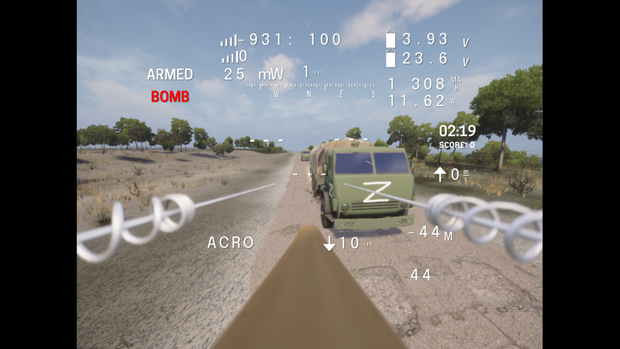
As of today, gamers worldwide have the chance to purchase and play a version of the “Ukrainian Fight Drone Simulator” (UFDS), originally developed as a training tool for the Ukrainian military during its efforts to counter the Russian invasion. This adaptation from a battlefield training simulator to a consumer video game represents a significant milestone, directly linked to Ukraine’s ongoing conflict with Russia.
The UFDS, available for purchase online for approximately $30, retains the highly realistic physics and piloting controls that have been instrumental in training Ukrainian drone operators to engage Russian tanks, missile launchers, and personnel. While the full simulator remains freely accessible to Ukrainian Armed Forces members, the consumer version aims to offer similar insights into drone piloting.
The Developers Behind UFDS
The conception and creation of UFDS stem from the efforts of Vladyslav Plaksin, the CEO of the Drone Fight Club Academy. This institution has been pivotal in training over 5,000 Ukrainian military drone pilots since its inception. With collaborations, including a joint training session with the U.S. Air Force at Ramstein Air Base, Germany, the academy plays a crucial role in enhancing Ukraine’s aerial combat capabilities.
One of the objectives of turning this military program into a game was to inspire young Ukrainians to learn drone piloting, according to Plaksin. By doing so, he hopes to offer them options beyond traditional combat roles. Interest in drones has surged among young Ukrainians, largely due to the actions and status of military drone pilots in the ongoing conflict.
From Training Tool to Video Game
UFDS markets itself as a public adaptation of an ultra-realistic first-person view (FPV) drone trainer, drawing from real-world experiences on the Ukrainian front lines. Players are given the opportunity to learn flying techniques akin to those employed by frontline pilots, tackling mission scenarios reflective of actual combat conditions. The game meticulously incorporates various drones, realistic weather conditions, and other elements to provide an immersive experience in drone warfare basics.
Unlike many simulators that offer FPV warfare with tanks, fighter jets, or submarines, UFDS stands out as the first to transition directly from military use to the household gaming setup.
Ethical Considerations and Security Measures
Plaksin recognizes the ethical questions that arise from creating such a realistic gaming experience, but he notes that similar simulators exist. UFDS is not unique in offering players a chance to engage in warfare through video games. Historically, the “America’s Army” series also served as a recruitment tool for the U.S. Army, although UFDS offers a heightened level of realism.
Security concerns are addressed by deliberately altering the game’s public version to prevent any potential misuse by adversarial forces, such as the Russian military. Differences between the consumer version and the military training software focus mainly on tactics, crucial for actual drone operation but streamlined in the game to maintain user engagement.
The game reduces elements considered tedious for players, like extended periods of flying to reach objectives, opting instead for an arcade-style gameplay that preserves realistic controls and interface.
Popularity and Future Aspirations
Currently, UFDS maintains a niche player base, with roughly 50 players active daily. Military simulation games often attract dedicated followers without reaching mainstream popularity. However, Plaksin aims to expand UFDS’s appeal by organizing competitions to increase player engagement and interest.
 SpaceX Secures $920 Million Monthly Deal with Google
  Protests Erupt in Albania Over Resort Development
  Clarity Sought on U.S. Troop Levels in Europe Amid Policy Changes
  U.S. Military Awaits Pentagon’s Clarification on Troop Levels in Europe
  Potential Ebola Outbreak in Central Africa Raises Concerns of Rapid Spread
  Meta and YouTube Ordered to Pay Damages in Landmark Social Media Lawsuit