School districts across the nation are facing the challenges of declining student enrollment, reduced funding, and expiring pandemic relief. This situation has led to intensified discussions about school closures and rightsizing. Leaders of both large urban systems and smaller districts are under pressure to consolidate and reduce expenses while striving to improve academic recovery for students.
Disproportionate Impact of School Closures
One key aspect of school closures is often overlooked: they do not affect all communities equally. Research indicates that Black students and students from low-income communities bear the brunt of these closures. These groups already face significant educational challenges post-pandemic, making the closures more problematic for them.
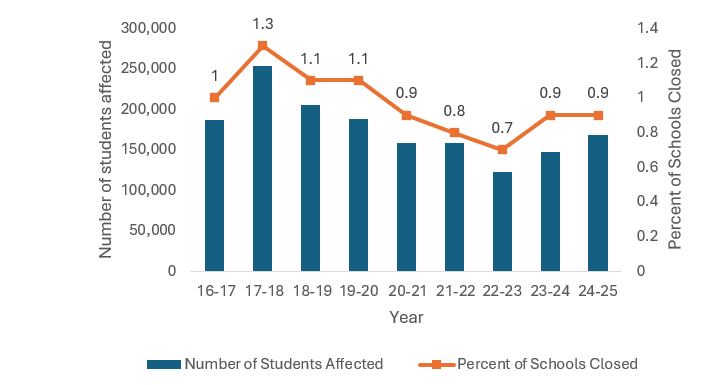
Analysis of data shows that around 1 percent of public schools have closed annually over the past decade. This equates to roughly 671 to 1,174 closures each year, impacting 100,000 to 250,000 students. It’s akin to displacing an entire student body from one large district every year.
The Return of Closure Pressures
The COVID-19 pandemic temporarily slowed permanent school closures due to paused accountability policies and federal relief funding. However, as these supports dwindled, closures have returned to pre-pandemic rates.
In 2017-2018, the national closure rate peaked at 1.3 percent and dipped to 0.7 percent in 2022-2023. Over the past two years, it rose again to 0.9 percent, indicating that pressure driving these closures has resurfaced.
Communities at Greater Risk
School closures tend to impact Black and low-income communities more severely. Historical research, including recent data from 2024-2025, shows that schools serving predominantly Black students represented about a quarter of closures, although they constitute less than 10 percent of all schools. High-poverty schools faced similar disproportionate closures.
In instances where enrollment dropped 50 percent, schools with all Black students were twice as likely to close compared to those without. Amid post-pandemic achievement trends, marginalized students—suffering the most significant academic setbacks—need stability to continue progress. Closing schools disrupts relationships and learning environments, risking the reversal of these gains.
Academic Disruptions and Limited Benefits
Closures bring disruptive academic and behavioral effects. Students reassigned to similar or lower-quality schools often experience achievement dips. In Chicago, displaced students showed setbacks in reading and math with little improvement unless transferred to better-performing schools. Philadelphia research echoed these findings, showing no overall achievement gains for displaced students unless they enrolled in superior schools.
Yet, displaced students lowering achievement levels in receiving institutions and facing longer commutes, increased absenteeism, and suspensions underscore systemic barriers such as inadequate transportation and limited seating that hamper academic benefits.
Fiscal Outcomes & Structural Issues
Contrary to intentions, school closures don’t always yield cost savings. National evidence suggests fiscal benefits of closures vary significantly. Texas-based research highlighted durable disruptions like declines in test scores, increased disciplinary incidents, lower high school completion, reduced college enrollments, and decreased employment and earnings.
The adverse effects are more pronounced for students from low-performing or economically disadvantaged schools. There’s a pressing need to confront inequities inherent in closure decisions; otherwise, Black and low-income students will continue bearing disproportionate harm.
Strategies for Equitable Closure Decisions
To preserve learning and promote equity, districts should right-size without dismantling neighborhood schools critical to Black and low-income communities. Where closures are unavoidable, they must be done equitably and transparently, engaging communities in the process.
Guaranteeing placements in no-worse schools for displaced students is crucial, stabilizing receiving institutions, lowering class sizes, enhancing transportation, and increasing counseling to avert adverse effects on attendance, climate, and achievement.
Policymakers must address root causes such as gentrification, declines in state education funding, and broader housing and economic disparities that reduced enrollment. District leaders cannot solely manage these structural problems. School closures redefine children’s daily lives, though at times unavoidable, repeatedly burdening the same communities should not continue.
State and district leaders can choose strategies that protect students’ progress, ensuring those owed the greatest educational debts don’t pay the highest price.
Megan Kuhfeld, Ph.D., serves as director of growth modeling and data analytics for Northwest Evaluation Association. Ayesha K. Hashim, Ph.D., is a lead research scientist.
© 2026 Nexstar Media Inc. All rights reserved. This material cannot be published, broadcast, rewritten, or redistributed.
 Students Use Glucose Monitors to Understand Their Health
  University of California Undertakes Review of Standardized Testing Policies
  Teachers Balancing Jobs to Meet Financial Challenges
  How to Prepare Your Child for Kindergarten
  Concerns Over Declining Math Scores and Economic Impact
  Recent Federal Test Scores Reveal Student Academic Trends