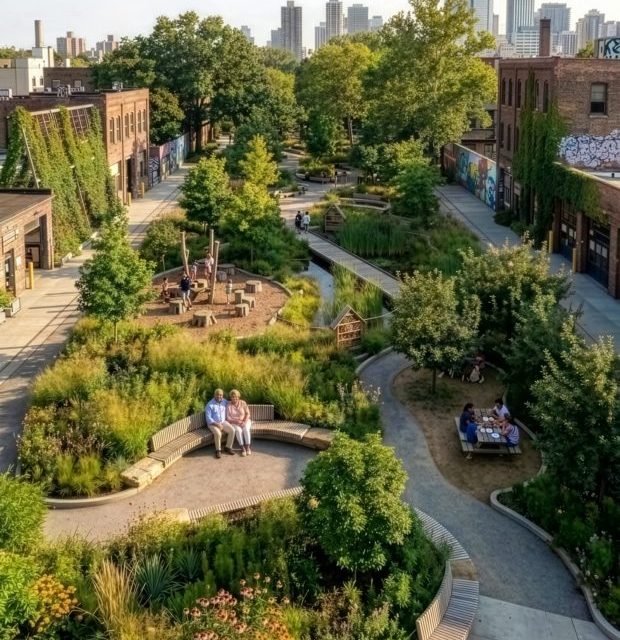
Over a century ago, architect Daniel Burnham crafted the 1909 Plan of Chicago, significantly influencing the city’s development. His approach inspired an enduring focus on parks and an open lakefront. Today, World Business Chicago seeks the next transformative vision with the ‘Horizon Lines’ open design contest. This spring, approximately 200 participants submitted ideas on how Chicago will evolve by 2050. Proposals range from constructing islands in Lake Michigan to installing themed public toilets citywide. On Wednesday, six concepts were chosen as finalists. These finalists are competing for a $5,000 prize and a chance for development.
Phil Clement, CEO of World Business Chicago, stated: ‘We asked Chicagoans to help us imagine the future of our city—visionary yet grounded in opportunity.’ The six finalists’ work, among other notable submissions, will be showcased at the Chicago Cultural Center this summer. Here, the public can view and vote on their favorites.
Green City Rising: Chicago’s Living Network of Neighborhood Arboreta
The Morton Arboretum aims to revive Chicago’s motto, ‘Urbs in Horto,’ or city in a garden, by planting mini-forests across neighborhoods. This proposal seeks to counterbalance urban concrete with forest canopies, reconnecting residents with nature. ‘We are missing forest canopy in our city,’ explained Elle Rampel, chief of staff at World Business Chicago. ‘People love trees.’
The Third Frontage Initiative
This initiative reimagines Chicago’s 1,900-mile alley network as a thriving residential area. Chicago architecture firms Gensler and Adrian Smith + Gordon Gill proposed turning these alleys into vibrant community spaces with green infrastructure and housing. ‘Chicago’s next great public realm may already exist, hidden in plain sight,’ commented the authors Tian Ouyang and Yibin Yang.
Repairing the Scars of the Interstate Highway Era
The Metropolitan Planning Council proposes covering parts of the Dan Ryan and Eisenhower expressways with green spaces. This plan turns highways into tunnels and transforms their surfaces into pedestrian parkways, reconnecting neighborhoods. Comparisons are made to Boston’s Big Dig project, which created 300 acres of open land. ‘On top, you have land that could be built, it could be taxed, it could be used for parks,’ stated Rampel.
Wonderways: Reimagining Chicago’s Boulevards
The MKSK design firm suggests redesigning Chicago’s historic boulevard system. The plan would use ecological and social landscapes to link surrounding parks, increasing the tree canopy and establishing prairies and trails. ‘This concept capitalizes on the boulevards that have made Chicago famous while incorporating more nature,’ said Rampel.
AgriFlats
Wheeler Kearns Architects propose converting food deserts into urban agriculture zones. This plan includes interconnected greenhouses for year-round farming, providing fresh produce to residents and restaurants. The initiative promises to create 230 jobs. ‘AgriFlats doesn’t just grow food,’ the proposal emphasizes. ‘It grows community.’
Re-Loop: The Living Mile
The Re-Loop Vision Coalition presents an ‘experience district’ featuring large sculptures made from recycled CTA rail steel. It includes spaces for food stalls and salvage businesses. The proposed site, near Rate Field, could become a prominent tourist destination. The plan may boost local tourism as the White Sox consider relocating their stadium.
World Business Chicago will announce the winning concept on September 15, with exhibits running until September 20. A $5,000 prize awaits the winner, and $1,000 goes to each remaining finalist. Attendees at the Cultural Center can submit feedback until July 24. Meanwhile, other creative entries, such as elevated structures or themed public toilets, highlight Chicago’s rich design legacy, despite not making the final cut.
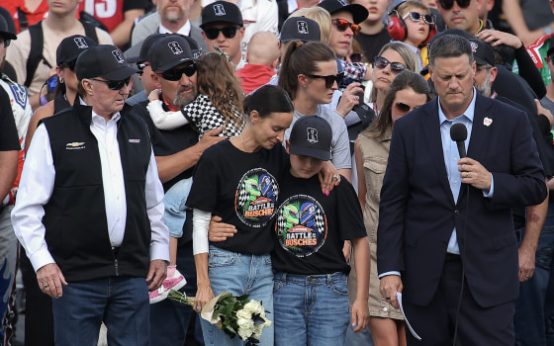 NASCAR Community Mourns the Loss of Kyle Busch
  Persistence in Investigations: Encouragement and Challenges
 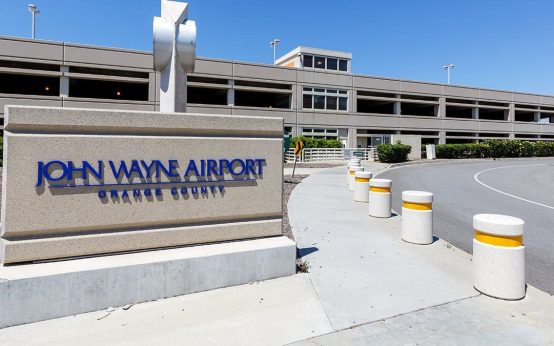 Support Pours in for Airport Worker After Viral Video
  Challenges of Reentry After Years in Prison
  YouTuber Sparks Debate Over Abortion Rights and Down Syndrome
  Significant Events in Chicago on June 5