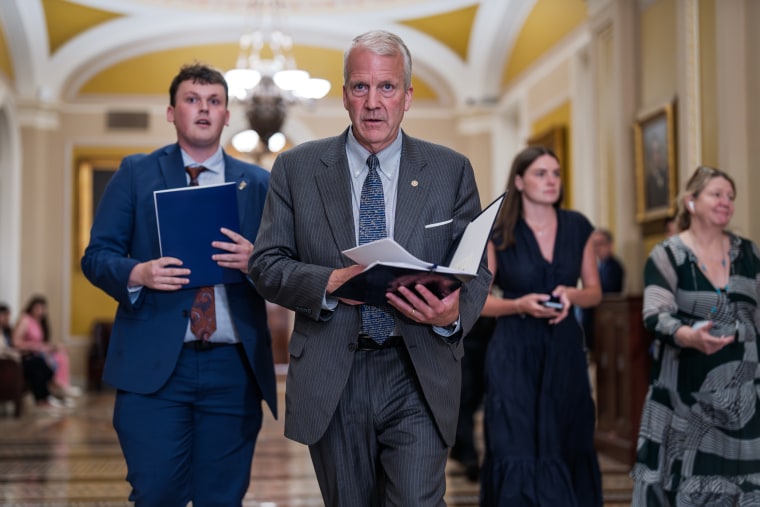
In Juneau, Alaska, a legal dispute has arisen involving a man sharing the name and party affiliation with Alaska Republican U.S. Senator Dan Sullivan. This individual challenged a decision made by Carol Beecher, the Director of the Division of Elections, to disqualify him from the primary ballot scheduled for August.
The challenge, put forth by Sullivan’s attorneys, claims that the disqualification violates state and federal law. They are seeking to have him placed on the ballot. The challenger Sullivan, a retired teacher from Petersburg, insists he is a qualified candidate for the U.S. Senate and argues that election officials lack a legal basis to remove him from the ballot.
According to the U.S. Constitution, the qualifications for the Senate are limited to age, citizenship, and residency. His legal team argues that Alaska law does not dictate any personal motivations behind declaring or campaigning for office. The filing was submitted by attorneys Jeffrey Robinson, Bryn Pallesen, and Zoe Eisberg.
Senator Dan Sullivan and the National Republican Senatorial Committee have criticized the challenger, calling him a sham candidate. They allege he is cooperating with Democrats to enhance the prospects of Democratic former U.S. Representative Mary Peltola. Both Peltola and the challenger have denied these accusations.
The dispute is part of a high-profile race with over a dozen candidates, viewed as a crucial battle in the midterm elections that both parties believe could affect control of the Senate.
Steve Kirch, a spokesperson for the Division of Elections, stated that the agency would not comment on ongoing reviews, investigations, or related proceedings.
On June 15, following a prior announcement of an investigation into the challenger by Republican Lt. Gov. Nancy Dahlstrom, Beecher disqualified the candidate. Beecher concluded that his candidacy was not a genuine effort for the U.S. Senate but aimed to mislead and impair ballot fairness and neutrality.
Dahlstrom cited credible allegations of coordination between Sullivan and another candidate, intending to confuse and mislead voters. However, Beecher noted there was no evidence of coordination with Peltola or Democratic Party officials when disqualifying Sullivan.
Sullivan asserted in an interview with the Associated Press that he had no communication with Peltola’s campaign.
Beecher based her decision on factors such as Sullivan’s voter registration under Daniel J. Sullivan Jr., his party affiliation change to Republican, and similarities in the campaign website designs resembling the senator’s site. She also mentioned his consultant connections with Democratic clients.
Congressional candidates in Alaska specify their ballot name preference and party affiliation on forms.
Beecher acted according to regulations stating that a candidate’s name should not appear in a misleading manner on ballots that might confuse voters or compromise electoral fairness.
In response to queries from Democratic state Rep. Andrew Gray, legislative attorney Andrew Dunmire indicated that Beecher’s regulation does not prohibit placing Sullivan’s name on the ballot. He suggested ballot design adjustments to allow voter distinction between the two individuals.
Sullivan initially received certification and was listed as Dan J. Sullivan, while Senator Sullivan appeared as Dan S. Sullivan and labeled as the incumbent. Alaska’s open primary system allows the top four vote-getters, irrespective of party, to advance to a ranked-choice general election.
 Majority of Brits Now Regret Brexit, Survey Reveals
  Supreme Court Decision Permits Stricter Immigration Controls for Green Card Holders
  Justice Department Withdraws Subpoenas Targeting Journalists
  Key Primaries in AI, Democratic Socialism, and Republican Endorsements
  Supreme Court’s Tariff Ruling: A Call for Fair Refunds
  Federal Judge Blocks Restrictions on SNAP Purchases of Sugary Products