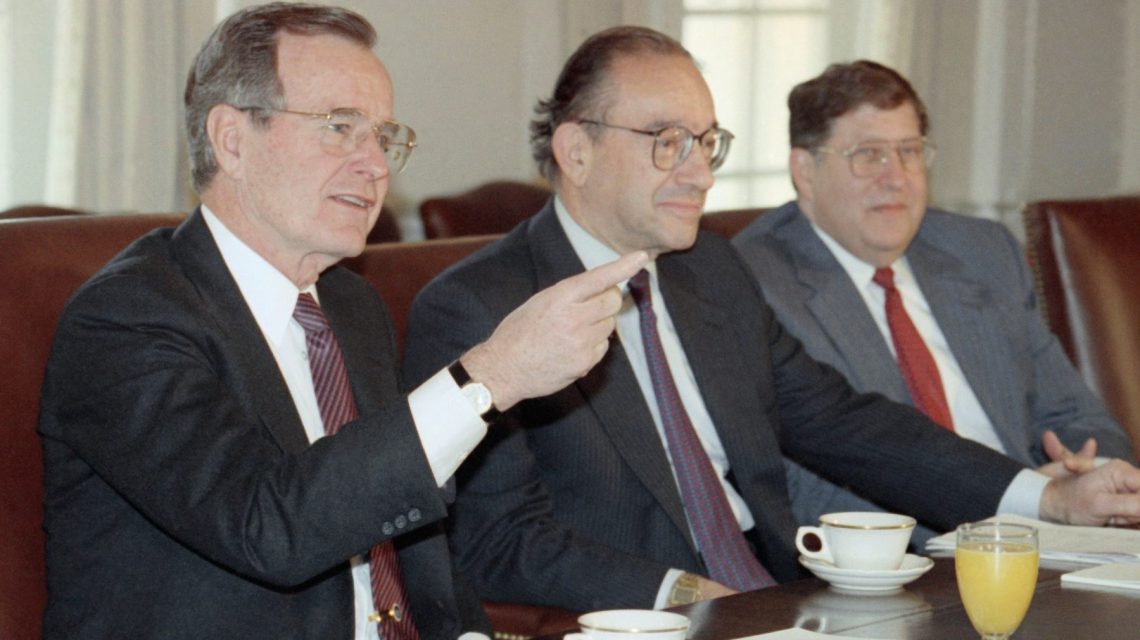
Alan Greenspan, the former chair of the U.S. Federal Reserve, died at the age of 100. The cause was complications from Parkinson’s disease, as reported by his wife, Andrea Mitchell, an NBC News correspondent. Greenspan and Mitchell had been married for 29 years. She described him as a husband who had a profound impact on her life since their first date in 1984. His passions included baseball, the Washington Commanders, tennis, golf, and jazz music. Mitchell highlighted his brilliance and kindness.
Era of U.S. Economic Growth
Greenspan led the Federal Reserve for over 18 years, during which the U.S. experienced notable economic growth. He was often celebrated as the ‘Oracle’ and ‘Maestro’ for his influence on the stock market and the economy. His tenure saw a decade-long economic boom starting in March 1991. Investors and analysts closely analyzed his statements for insights into interest rates and market trends. His leadership at the Fed was marked by the ‘Briefcase Indicator,’ a symbol of potential changes inferred when he carried a stuffed briefcase to meetings.
Under Greenspan, the Fed achieved a period of price stability that supported economic growth and bolstered public confidence. The institution credited him with imposing rigorous analytical discipline in monetary policymaking, contributing to the Fed’s credibility.
U.S. Housing Crisis Raises Questions
Greenspan’s reputation faced challenges following his departure from the Fed in 2006. The American housing market crash triggered a global financial crisis, leading to a severe recession. Critics attributed part of the crisis to Greenspan’s policies, which included low interest rates and a reliance on lightly regulated financial markets. Greenspan admitted his mistake in assuming banks could effectively self-regulate. The housing market’s downturn resulted in widespread foreclosures and economic deterioration.
The aftermath of the U.S. crisis affected Europe and required China to implement a major stimulus package. These global repercussions further questioned the policies during Greenspan’s tenure.
Greenspan’s Global Influence
“I know you believe you understand what you think I said, but I am not sure you realize that what you heard is not what I meant,” Greenspan humorously remarked about his complex speeches.
Internationally, Greenspan was seen with reverence and his statements impacted financial markets worldwide. His comments on stock market valuations in 1996, particularly ‘irrational exuberance,’ are famous for shaking up financial markets. His tactics often involved deliberate ambiguity to manage his influence.
Early Years and Education
Greenspan grew up in Manhattan’s Washington Heights as a talented math student. In his youth, he performed as a musician before deciding on an economics career. Greenspan attended New York University, ultimately earning a doctorate in economics. His career spanned decades of running an economic consulting firm.
In the 1950s, he became a follower of Ayn Rand, gaining the nickname ‘Undertaker’ for his demeanor and clothing. He became involved in politics as President Gerald Ford’s chief economic adviser in 1974, with Rand present at his swearing-in.
Challenges as Fed Chair
Appointed by President Ronald Reagan in 1987, Greenspan confronted immediate challenges. During ‘Black Monday’ in October 1987, the stock market experienced a massive one-day loss. Greenspan’s reassurance that the Fed would support the financial system restored stability, allowing the economy to bounce back.
His crisis management skills were tested again during the Asian financial crisis of the late 1990s. Greenspan’s Fed intervened with solutions, such as emergency loans and financial negotiations, to safeguard global economic stability.
During his tenure, Greenspan oversaw a historic economic expansion, characterized by low unemployment and minimal inflation. He argued that technological advances allowed for economic growth without causing inflation, which enabled the Fed to maintain low interest rates.
Legacy and Later Life
After his Federal Reserve career, Greenspan remained active, running his consulting firm and contributing economic insights. He published several books and participated in media discussions. He advocated for the Fed’s independence amid political pressures, aligning with other former Fed leaders on these matters.
In his writing, Greenspan defended his economic policies against criticism, emphasizing the challenges of predicting financial bubbles. He identified irrational risk-taking as a significant contributor to economic crises.
Alan Greenspan’s life and career left an indelible mark on U.S. and global economic policies. His leadership, both lauded and scrutinized, continues to influence economic thought and policy.
 Fire in Boyle Heights Cold Storage Continues
  Significant Events in Chicago History
  Wildfires Continue to Rage Across Western U.S.
  Los Angeles Fire Prompts Emergency Declarations and Health Concerns
  Chicago Faces Rising Gun Violence: Calls for Federal Intervention
  New York Times Faces Criticism Over Father’s Day Transgender Parenting Essay