
The announcement of a peace agreement between the U.S. and Iran has raised hope for reducing gas prices to pre-war levels. However, analysts caution that an incoming tropical storm may delay this potential relief for American drivers.
During the weekend, officials from both countries revealed they had reached an agreement to end the conflict of more than three months. While details are sparse, President Donald Trump indicated that a memorandum of understanding has been signed, with an official ceremony planned in Switzerland.
Impact on Oil Prices
The prospect of reopening the Strait of Hormuz, which handles a significant portion of the world’s seaborne oil trade, has led to a steep fall in oil prices. If the agreement remains effective, a similar, albeit slower, decrease in domestic gas prices is anticipated. However, the forming tropical storm off the Gulf Coast may hinder this progress.
Patrick De Haan, a senior petroleum analyst at GasBuddy, expressed concern over the storm’s effect on regional refineries. He stated, “This could slow down gasoline and diesel price relief,” in a social media post.
Tropical Storm Threat
Meteorologists are closely watching a low-pressure system along the Texas coast, potentially the first named storm of the 2026 Atlantic hurricane season. According to a Wednesday update from the National Hurricane Center (NHC), the storm is moving northeast along Texas and is expected to cause flooding in parts of the Southeastern U.S. The system could reach southwestern Louisiana by Wednesday night, bringing strong winds and heavy rainfall.
The Gulf Coast, which includes Texas, Louisiana, Alabama, and Mississippi, hosts the highest concentration of refineries in the nation. As a response, TACenergy, a Dallas-based fuel distributor, highlighted the potential risks, noting that over a quarter of U.S. refining capacity could be affected. Reuters reports indicate that precautionary measures, such as securing equipment, are being undertaken by refineries in the region.
Gas Prices: A Gradual Recovery
As per GasBuddy, the national average for regular unleaded gas stood at just under $4 per gallon on Wednesday morning, a drop of approximately 48 cents over the last month. Despite this, prices remain higher than the $3 average before the conflict started on February 28.
Beyond the storm’s impact, analysts assert that even with a lasting agreement, it will take time for gas prices to stabilize after supply chain disruptions caused by the conflict. Bob McNally, president of Rapidan Energy Group, shared with Newsweek, “Assuming the ceasefire holds, it will take many months for oil flows to recover.”
Keland Rumsey from East Daley Analytics also highlighted that pump prices traditionally do not immediately reflect changes in crude oil prices. He explained, “A return to pre-war gasoline prices would depend not only on crude markets but also on refinery operations, seasonal demand, and whether any geopolitical risk premium remains in oil prices.”
 Texas Highway Plane Crash Investigation
  Lake County Declares Local Disaster Emergency After Tornadoes
  Tragic B-52 Crash at Edwards Air Force Base Claims Eight Lives
 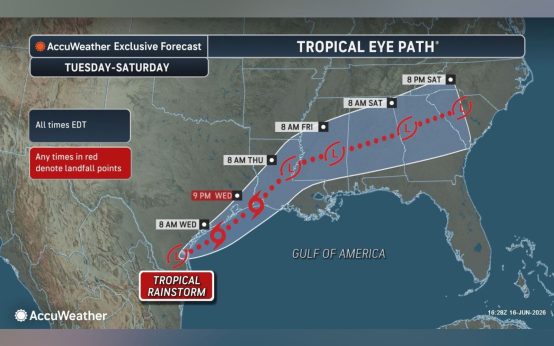 Monitoring of Potential First Storm in 2026 Atlantic Hurricane Season
  New York City Hosts Championship Ceremony for Knicks
  New Area Code Introduced in New York City