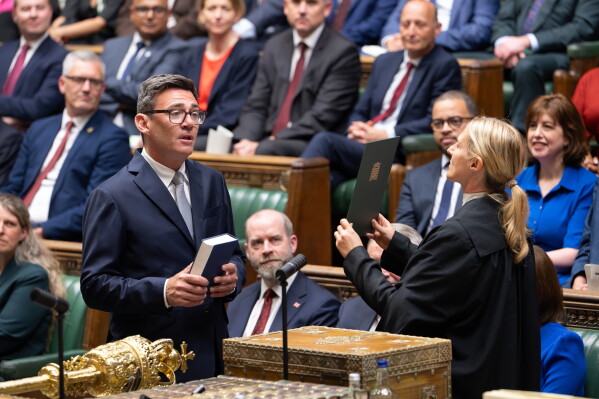
Newly elected British lawmaker Andy Burnham met Prime Minister Keir Starmer on Tuesday, aiming to challenge him for Labour Party leadership. Burnham is a strong candidate to succeed Starmer, who announced his impending resignation after two years plagued by errors that harmed his reputation within the party and the public.
Burnham, previously a Cabinet minister and now mayor of Greater Manchester, won a special election for a seat in Parliament to contest Starmer’s leadership. His prospects improved when Wes Streeting, former Health Secretary, backed him.
Starmer and Burnham met for the first time after Burnham’s election. The conversation’s content remains undisclosed, but Burnham is actively engaging with Labour lawmakers to gain support.
The UK’s parliamentary system permits governing parties to change leaders, and thus prime ministers, without national elections. The next general election is scheduled for 2029. Labour leadership nominations will open on July 9 and close a week later. If Burnham runs unopposed, he may become prime minister by July 17. If there’s a contest, the new leader will likely be in place by September 1 following Parliament’s summer recess.
Starmer is committed to a smooth transition, aiming for the new leader’s success. Though he maintains a busy schedule, his final days will exclude major policy announcements or spending commitments.
Due to political uncertainty, the European Union postponed a scheduled UK-EU summit set for July 22. Meanwhile, the British government plans to publish a defense investment plan before an upcoming NATO summit.
Though Burnham’s economic strategies are not fully disclosed, he promises to expand his successful “Manchesterism” ideology nationally. His popularity in Manchester, highlighted by the city’s regeneration, contrasts with Starmer’s management-focused style.
Despite Burnham’s appeal, some Labour members advocate for a leadership contest where his policies can undergo scrutiny in public debates. Burnham is expected to present economic proposals soon.
Potential challengers such as Al Carns, former Armed Forces Minister, and Darren Jones, a senior Cabinet minister, could enter the race. Candidates need backing from at least 81 Labour lawmakers.
Many believe a leadership contest will underscore party divisions and prolong political uncertainty.
Starmer resigned after acknowledging that the Labour Party considers him unsuitable to lead into the next general election. He becomes the sixth prime minister in ten years to step down, coinciding with the tenth anniversary of Britain’s EU departure vote.
Starmer initially resisted resignation, but ultimately yielded to pressure for change to revitalize Labour’s declining fortunes. Despite leading Labour to electoral success in 2024, his subsequent popularity waned alongside party support.
Starmer’s tenure faced setbacks including failure to deliver economic growth and remedy public services, compounded by errors like appointing Peter Mandelson as U.K. ambassador.
Labour now struggles against the growing Green Party and Nigel Farage’s Reform UK, which leads national polls.
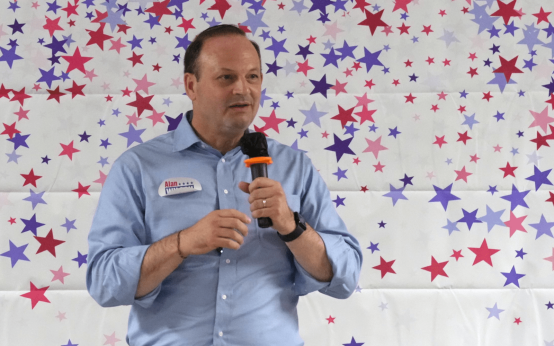 South Carolina Gubernatorial Runoff: Polls Indicate Strong Support for Alan Wilson
 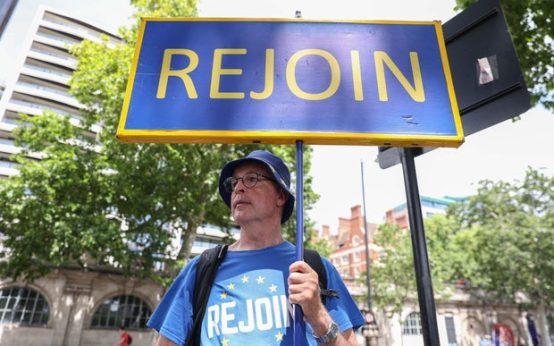 Majority of Brits Now Regret Brexit, Survey Reveals
  Supreme Court Decision Permits Stricter Immigration Controls for Green Card Holders
  Justice Department Withdraws Subpoenas Targeting Journalists
  Key Primaries in AI, Democratic Socialism, and Republican Endorsements
  Alaska Candidate Disqualification Sparks Legal Challenge