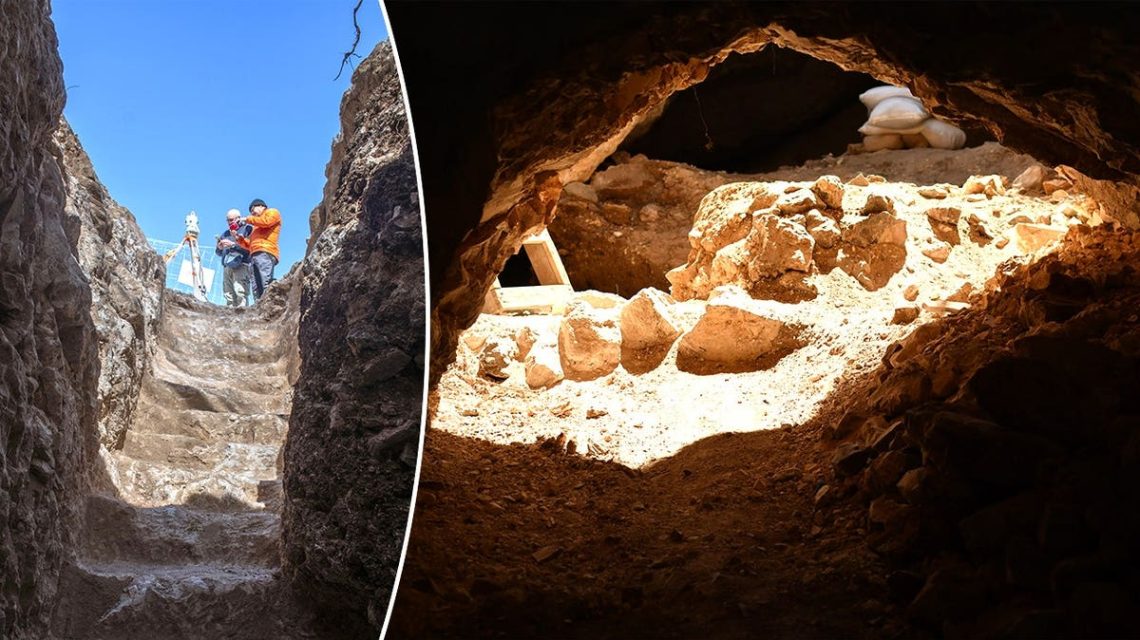
Excavators have uncovered a fascinating ancient tunnel near Jerusalem, close to sites linked to the biblical Kingdom of Judah. The Israel Antiquities Authority (IAA) announced this discovery on May 14. The tunnel was located near Kibbutz Ramat Rachel, an archaeological site associated with the Kingdom of Judah, as previous IAA works have shown.
The rock-hewn tunnel is approximately 164 feet long and was discovered during pre-construction excavations for a new residential neighborhood north of Ramat Rachel. The tunnel measures around 16 feet in height and 10 feet in width. The IAA noted the tunnel’s careful and precise construction.
The tunnel itself was discovered filled with layers of soil that had accumulated over hundreds, perhaps even thousands, of years.
Excavation directors Sivan Mizrahi and Zinovi Matskevich expressed astonishment at the find. They explained that they were working in a rocky and exposed area when they stumbled upon a natural karstic cavity. As excavations continued, this developed into a long tunnel. Although parts remain collapsed, revealing all its secrets is a work in progress.
In 2020, excavations near Ramat Rachel unveiled seal impressions and structures linked to the Kingdom of Judah, suggesting governmental activities in the area. However, no evidence yet ties the new tunnel directly to the Kingdom of Judah or the biblical era, and the tunnel’s exact age is unknown.
The tunnel is situated only a few hundred meters from two notable ancient sites: a public building from the Iron Age in Arnona and Tel Ramat Rachel, where remains from the Iron Age through the Islamic period have been documented. Signs of substantial planning and labor efforts are evident inside the tunnel.
Researchers suspect the tunnel might have been carved to access a chalk layer for quarrying stones or lime production. Ventilation features, like a shaft in the ceiling, and quarrying debris on the floor, may support this theory, although it remains uncertain.
The IAA has ruled out the possibility of the tunnel being part of an ancient water system. Some experts propose that the site might have been abandoned before construction concluded or that the quarrying and tunnel construction never finished, leaving its purpose unknown.
Amit Re’em, a Jerusalem district archaeologist at the IAA, remarked that this discovery is part of a continuous stream of findings throughout the city, highlighting the ongoing work of archaeologists and researchers in Jerusalem.
 YouTuber Shares Difficult Decision After Trisomy 21 Diagnosis
  The Changing Dynamics of Celebrity Reputation in 2026
  Robbers Sentenced for Theft of Romanian Treasures from Dutch Museum
  YouTuber Sparks Debate Over Abortion Rights and Down Syndrome
  Celebrate America’s 250th Birthday with Commemorative Products
  Flesh-Eating Fly Returns to the United States Causing Concern