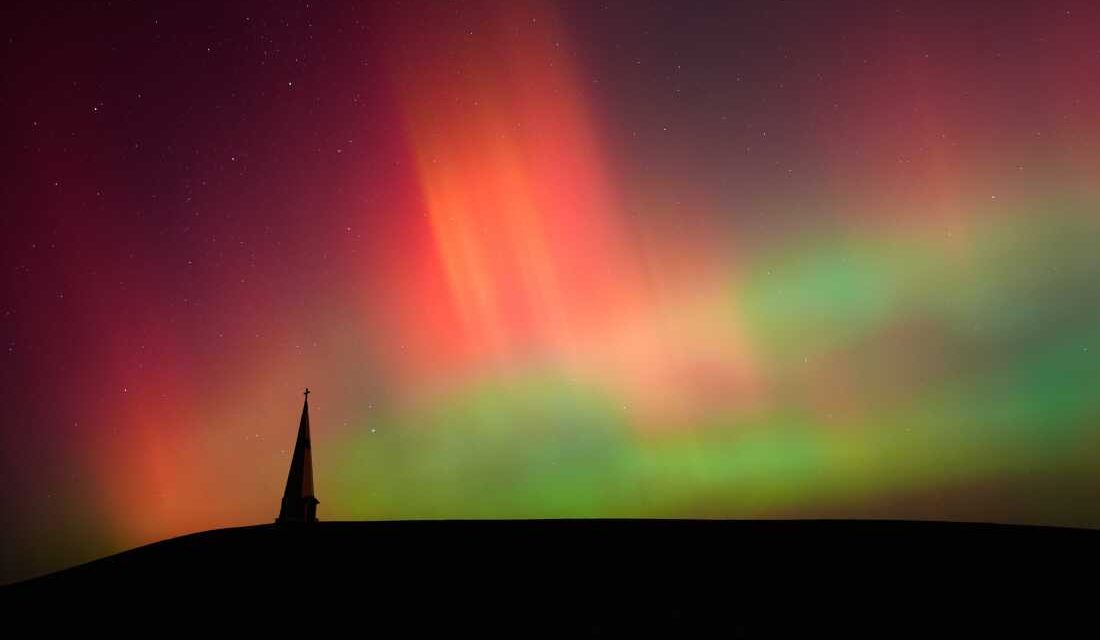
The night sky over North America promises a spectacular view of brilliant green, purple, and pink lights. These splashes of color result from the Northern Lights or aurora borealis, a phenomenon where energized particles from space collide with the Earth’s atmosphere.
The best opportunities for viewing will occur in the northern United States and much of Canada. The National Oceanic and Atmospheric Administration (NOAA) notes that the most captivating displays happen where the aurora is directly overhead, but they can be seen from up to 1000 km away. The optimal times are shortly after sunset or just before sunrise.
This impressive light show stems from space weather events. According to NASA, it occurs when high-energy particles from space violently collide with atmospheric gas atoms near the planet’s magnetic pole. The geomagnetic storm creating this aurora will peak on Saturday night, making it the best time for observation, as noted by NOAA.
For those residing away from the poles, witnessing the auroras can be a unique experience. In North America, the best months to observe these lights are March and November, though scientists are still studying the cause. Typically, the best places to view auroras are in the northernmost latitudes of the Earth, in countries like Russia, Norway, and Sweden, as well as Greenland and Alaska.
“For many, the aurora is a mesmerizing nighttime event worth traveling to arctic regions to see,” says NOAA. “It offers most people their only real encounter with space weather.”
 Limited Interest in Arctic National Wildlife Refuge Oil Auction
  Confronting the Truth Behind Sustainability Buzzwords in the Food Industry
  The Aftermath of Santa Rosa Island’s Fire
  Largest Seizure of Illegal Cockroaches in Australia
  Flesh-Eating Fly Returns to the United States Causing Concern
  Australia’s Largest Seizure of Exotic Invertebrates: Over 100,000 Cockroaches Confiscated