
On Wednesday, Venezuela endured two powerful earthquakes, causing significant destruction and exacerbating the nation’s existing political and economic challenges. The earthquakes resulted in at least 32 deaths and injured 700 people. President Delcy Rodríguez announced the casualties but noted the toll from La Guaira, the hardest-hit state, was not yet included.
In Caracas, Venezuela’s capital, buildings collapsed, prompting citizens to evacuate to the streets. Power outages plunged numerous neighborhoods into darkness, disrupting subway and train services, and flooding streets due to burst water pipes. Rodríguez declared a state of emergency, urging healthcare professionals to report to work, and mentioned available shelters for those displaced.
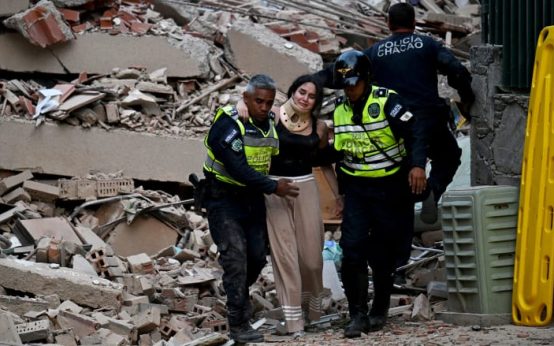
Videos on social media, verified by The New York Times, depicted the devastation. In La Guaira, some buildings were reduced to rubble, forcing people at Simón Bolívar International Airport to seek cover. Rescuers combed through the debris in Caracas, searching for missing individuals.
The first quake struck after 6 p.m. Eastern time with a magnitude of 7.2, followed by a 7.5-magnitude quake. This was the strongest earthquake since 1900 in the region. The epicenter was located near San Felipe in the state of Yaracuy.
Widespread Impact
The earthquakes caused widespread infrastructure disruptions. Gas supplies were shut off, and water services suffered interruptions. Many buildings collapsed or sustained damage, with La Guaira experiencing severe destruction. Rodríguez mentioned La Guaira bore the worst impact, with numerous structures collapsing.
International Aid and Support
Several countries offered humanitarian aid and rescue teams. Among them were the United States, the Dominican Republic, El Salvador, Mexico, and Qatar. President Rodríguez expressed gratitude to international leaders via social media. Notably, Chef José Andrés pledged $1 million for relief efforts through his organization, World Central Kitchen.
In Caracas, emergency response was hindered by road closures, power outages, and communication difficulties. However, rescue personnel persevered, working in affected areas despite challenges.
Historical Context and Comparisons
The magnitude 7.5 earthquake is the largest in Venezuela since the San Narciso Quake of 1900. Historically, such seismic events have drastically impacted the region. Venezuela’s geological setting between South American and Caribbean tectonic plates often results in earthquakes.
Other significant quakes have occurred, such as in 2018 with a magnitude of 7.3, and in 1997 with a 7.0-magnitude quake.
Wednesday’s disaster drew comparisons to past seismic events, reflecting Venezuela’s vulnerability. Footage and pictures from the disaster site showed scenes of destruction, with emergency workers striving to rescue survivors amidst rubble.
Affected Communities and Global Response
The Venezuelan diaspora, particularly in South Florida, expressed concern for those affected and mobilized aid efforts. Individuals in Doral, heavily populated by Venezuelans, coordinated local assistance efforts, illustrating profound community bonds across borders.
U.S. officials indicated readiness to provide aid, releasing statements of support geared toward easing Venezuela’s humanitarian crisis.
In summary, Venezuela is grappling not only with a devastating natural disaster but also continued political as well as economic strife, underscoring the need for expansive international aid and structural recovery efforts.
 Twin Earthquakes Devastate Venezuela: International Aid and Rising Casualties
  North Korea Commissions Largest Warship Yet, Armed with Nuclear Missiles
  Powerful Earthquake Strikes Off Japan’s Northern Coast; No Tsunami Warning Issued
  Mexico’s Historic Journey at the World Cup
  Earthquake Devastates Venezuela: Immediate and Global Responses
  2026 World Cup Day 14 Coverage