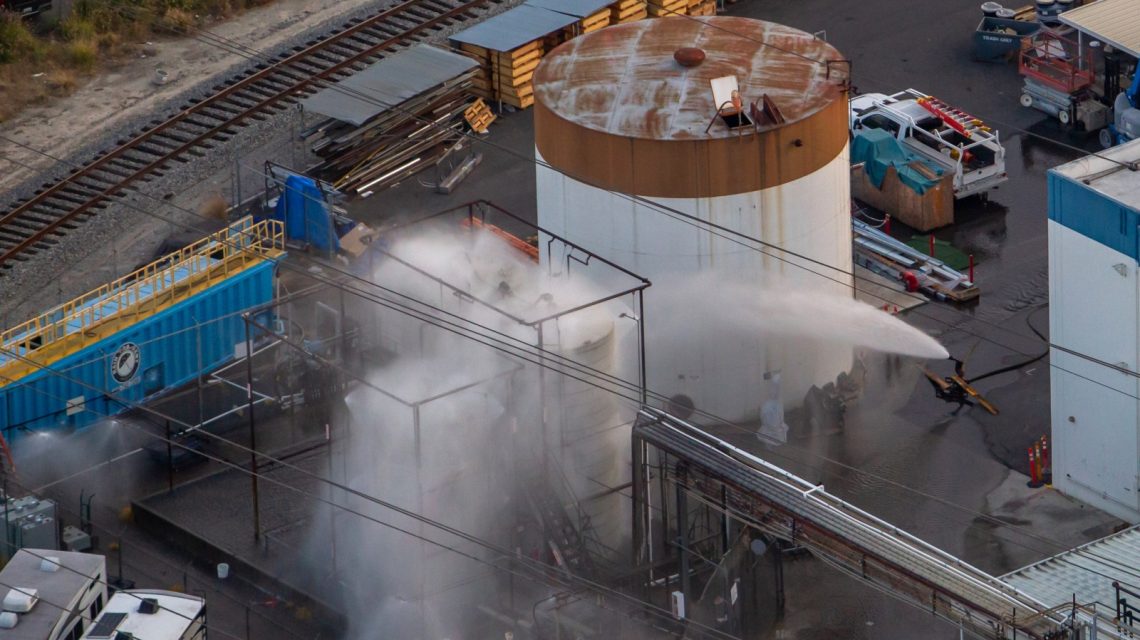
In Southern California, a chemical tank containing methyl methacrylate has reached temperatures of at least 100 degrees Fahrenheit, escalating the risk of a potentially catastrophic explosion. Located in Garden Grove, the tank poses a significant threat to surrounding communities due to its volatile contents. Firefighters are working diligently to stabilize the situation.
Emergency Response and Structural Developments
Fire crews have been racing to manage the tank, which holds thousands of gallons of methyl methacrylate, commonly used in plastics and aerospace industries. On Sunday, Senator Tom Umberg relayed concerns about a possible “thermal runaway” reaction. Such a reaction could lead to an explosion.
A crack discovered in the tank may act as a pressure-release valve, allowing gases to escape and reducing internal pressure. Orange County Fire Authority’s interim fire chief, T.J. McGovern, acknowledged this crack could alter response strategies. This kind of venting can mitigate the risk of a violent rupture caused by rising vapor pressure.
The Fire Authority has clarified misinformation about multiple cracks. They confirmed only one crack exists, and there is no active leak. This was supported by continuous atmospheric monitoring.
Weather’s Impact on Stabilization Efforts
Weather conditions are also aiding efforts. Meteorologist Joe Wegman noted that mild temperatures and limited winds are forecasted for the area, which helps reduce stress on the tank. Temperatures in the low 70s during the day and lows in the 50s at night slow heat buildup inside the tank. Light winds prevent widespread contamination if vapors are released. However, even light winds could carry these vapors into populated areas.
Firefighters are using water to manage the tank’s temperature, an approach more effective in stable weather. These factors combined have slowed the approach to a worst-case scenario but do not eliminate the risk entirely.
Background of the Incident
The emergency began on May 21 when the tank at a GKN Aerospace facility began overheating. A defective valve hindered efforts to drain or neutralize the chemicals. This situation has led to significant community disruption, with over 40,000 residents evacuated. Evacuees have shared experiences of uncertainty and urgency in leaving their homes quickly.
This event has been one of California’s most complex hazardous materials emergencies, necessitating multi-agency cooperation in monitoring and coordination efforts.
Federal and State Government Involvement
The White House confirmed its involvement through the EPA, which has set up air quality monitoring systems across the area. The EPA’s efforts have shown no detectable hazardous levels currently. FEMA has also been engaged in contingency planning, while the federal response includes plume modeling of airborne hazards.
California Governor Gavin Newsom’s declaration of a state of emergency aims to acquire additional funds and resources, assisting both the stabilization process and the displaced population. State officials have engaged in setting up emergency shelters and coordinating with federal efforts to ensure safety.
Continuing Threat and Uncertainty
Despite initial signs of decreasing pressure, significant dangers remain. The tank’s stability is not guaranteed, and authorities are concerned about potential temperature spikes. Current monitoring systems have reached their measurement limits, creating uncertainty about the tank’s actual condition.
Evacuation orders persist, with authorities conducting round-the-clock operations to monitor pressure levels and prepare for any developments.
 Confronting the Truth Behind Sustainability Buzzwords in the Food Industry
  The Aftermath of Santa Rosa Island’s Fire
  Largest Seizure of Illegal Cockroaches in Australia
  Flesh-Eating Fly Returns to the United States Causing Concern
 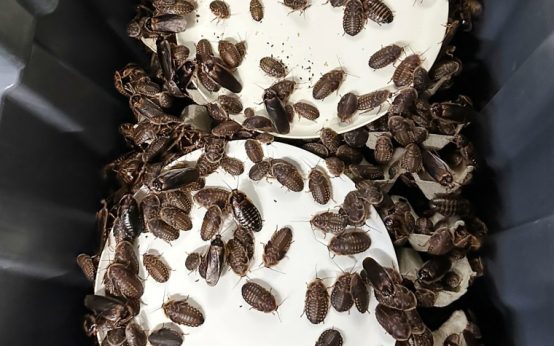 Australia’s Largest Seizure of Exotic Invertebrates: Over 100,000 Cockroaches Confiscated
  New Threat to U.S. Cattle Industry: The Screwworm Infestation