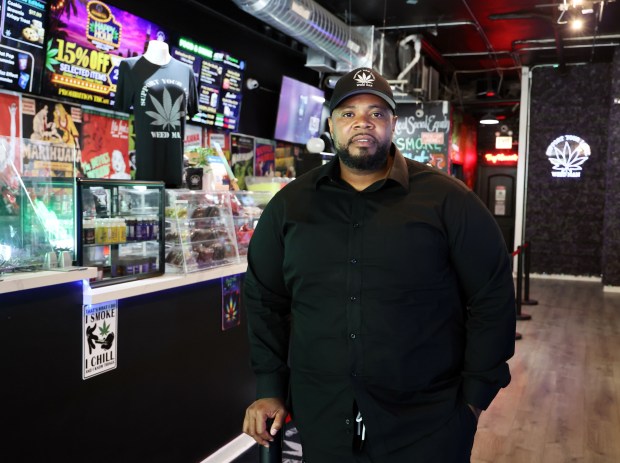
After the legalization of hemp in 2018, Samuel Wilson co-founded Prohibition THCafe, offering hemp-derived THC edibles and beverages in Chicago’s Near South Side. The cafe drew attention during the 420 cannabis holiday by collaborating with Harold’s Chicken to serve THC-infused wings, attracting large crowds.
However, new legislation threatens the future of Wilson’s business. A federal law and an Illinois state measure aim to restrict hemp sales to only licensed dispensaries. The Illinois proposal, which awaits Governor JB Pritzker’s signature, intends to curb the sale of untested hemp products to minors and unregulated outlets.
Wilson, who claims his products are tested and only sold to individuals aged 21 and above, expressed concern. He noted, “I was that innovator who chased the American Dream. To see that now in jeopardy… it’s a hijacking of small operators and handing it over to corporate cannabis.”
Licensed cannabis businesses advocate for the bill, targeting unregulated hemp shops that bypass testing and labeling requirements. They argue this legislation is essential since the allowance of recreational cannabis sales in Illinois in 2020.
The federal law is set to restrict sales of products with over 0.4 milligrams of tetrahydrocannabinols, while the state measure proposes even broader limits. Both laws are slated for implementation in November. Wilson hopes for a change in the federal stance, although it remains challenging. Regardless, the Illinois law would stop unlicensed hemp sales.
Hemp businesses have established a notable presence in Illinois, with over 1,000 retailers generating around $870 million in sales in 2025 and employing nearly 13,000 people, according to a Whitney Economics survey.
The Illinois ‘omnibus’ bill would also bring changes to licensed cannabis operations. The maximum allowed amount for cannabis possession would double. Illinois residents could possess up to 60 grams of flower, 1,000 milligrams in infused products, and 10 grams of concentrate, while out-of-state residents may possess half these amounts.
Business hours for dispensaries could extend to 2 a.m., with flexibility for local communities to set closing times. The bill would also expand access for medical cannabis users, enabling any licensed dispensary to sell medical cannabis, which is not subject to high retail taxes. This could benefit newer dispensaries by allowing them to take standard business tax deductions.
The bill proposes additional conveniences like drive-thru service and allowing cannabis in original sealed packaging in cars. Tiffany Ingram, executive director of the Cannabis Business Association of Illinois, supported these developments, calling Senate bill 3222 “one of the most consequential cannabis bills since legalization.”
Ingram highlighted that hemp business owners can apply for up to 145 new licenses to infuse and sell THC products. State Sen. Kimberly Lightford, a long-time supporter of hemp restrictions, stated, “Together, these changes formalize the hemp market, modernize cannabis operations, and lower barriers for both patients and smaller operators.”
Should the bill become law, it would immediately ban intoxicating hemp sales to those under 21 and outlaw deceptive marketing targeting children. State Rep. Will Guzzardi explained it would also lift the requirement for dispensaries to hire external security. Enforcement, given the federal manpower shortage, would largely fall on state regulators and local police.