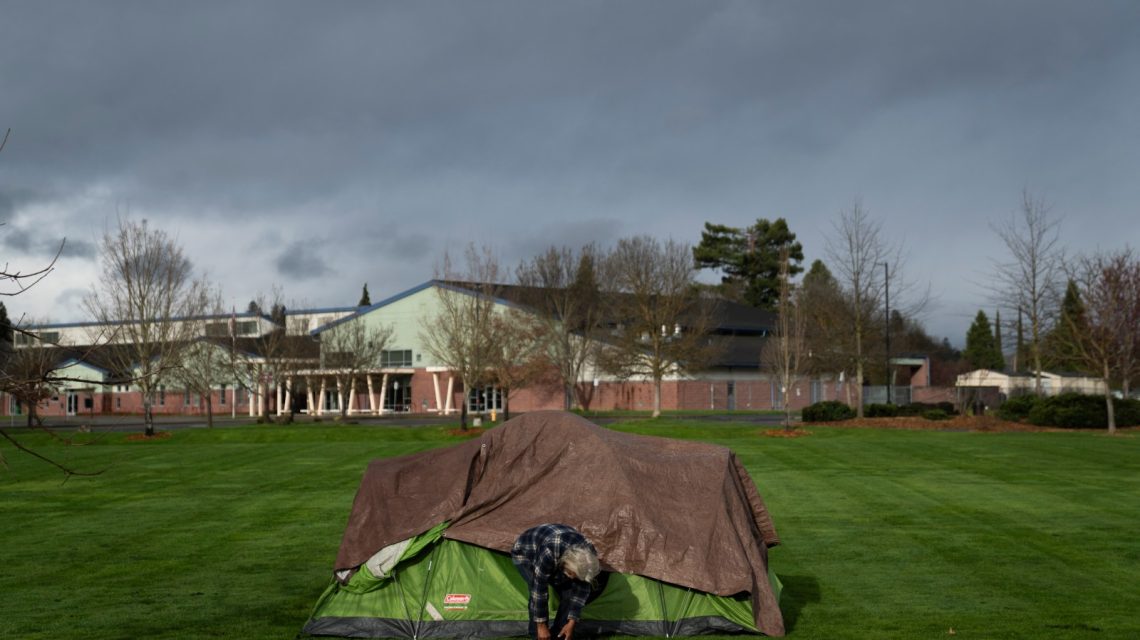
New research reveals a substantial increase in homeless encampment “sweeps” in Oakland, California, following a Supreme Court decision. The city saw these actions more than double after the Court’s 2024 ruling, enabling municipalities to enforce camping bans despite limited shelter availability.
Supreme Court Ruling in City of Grants Pass v. Johnson
The Supreme Court ruled in favor of a southern Oregon city in the 2024 case, City of Grants Pass v. Johnson. The case challenged the enforcement of anti-camping ordinances against homeless individuals. Plaintiffs argued the city penalized unhoused residents for sleeping outdoors when no shelter space was available. The Court’s 6-3 decision determined that such enforcement does not breach the Eighth Amendment’s ban on cruel and unusual punishment. This decision widened city powers to dismantle homeless encampments and enforce camping bans.
Previously, in September 2022, the Ninth U.S. Circuit Court of Appeals had found these ordinances unconstitutional. The Supreme Court ruling overturned that decision.
Research Findings on Encampment Sweeps
Using data from 785 encampment closures recorded in a City of Oakland database, researchers observed a rise in closures from an average of 14.4 per month (between 2021 and 2024) to 32.2 per month post-ruling. Of these, new closures averaged 17.5 per month, with repeat closures at 14.7.
The study noted a particular encampment closed 18 times over four years. It highlighted significant demographic differences in neighborhoods affected by closures, with higher occurrences in areas with larger Hispanic and Black populations.
Increases in new closure sites and distinct neighborhood characteristics raise two interpretations: (1) the ruling enabled enforcement expansion to new areas, and (2) new, dispersed encampments emerged in response to prior closures.
Jamie Chang, senior study author and associate professor at the University of California, Berkeley, questioned the effectiveness of sweeps. She stated, “The repetition and dispersive effect of sweeps raise questions about their role in managing homelessness.”
Co-author C.J. Gabbe, an associate professor at Santa Clara University, expressed concern that Oakland’s approach displaces vulnerable individuals into more precarious situations rather than providing stability.
Homelessness in the United States
Homelessness remains a widespread issue in many U.S. cities, compounded by limited shelter capacity and affordable housing shortages. The U.S. Department of Housing and Urban Development’s 2024 report identified California as having the largest homeless population at 187,000, followed by New York with approximately 158,000. Florida and Washington each reported over 31,000 people experiencing homelessness.
In January 2024, over 770,000 individuals were reported homeless, marking an 18% increase from 2023. President Donald Trump has vowed to utilize all available means to address this crisis. In March 2025, he signed an executive order directing the National Park Service to clear homeless encampments and graffiti from federal lands in Washington D.C.
 Investigation into Bus Company’s Network and Safety Violations
  Inflation’s Rise Challenges Economists’ Claims
  Support Pours in for Airport Worker After Viral Video
  Father Shares Water Safety Lesson After Daughter’s Close Call
  Food Banks Struggle with Rising Fuel Costs Due to War in Iran
  US Postal Service’s Financial Future Secured for Now