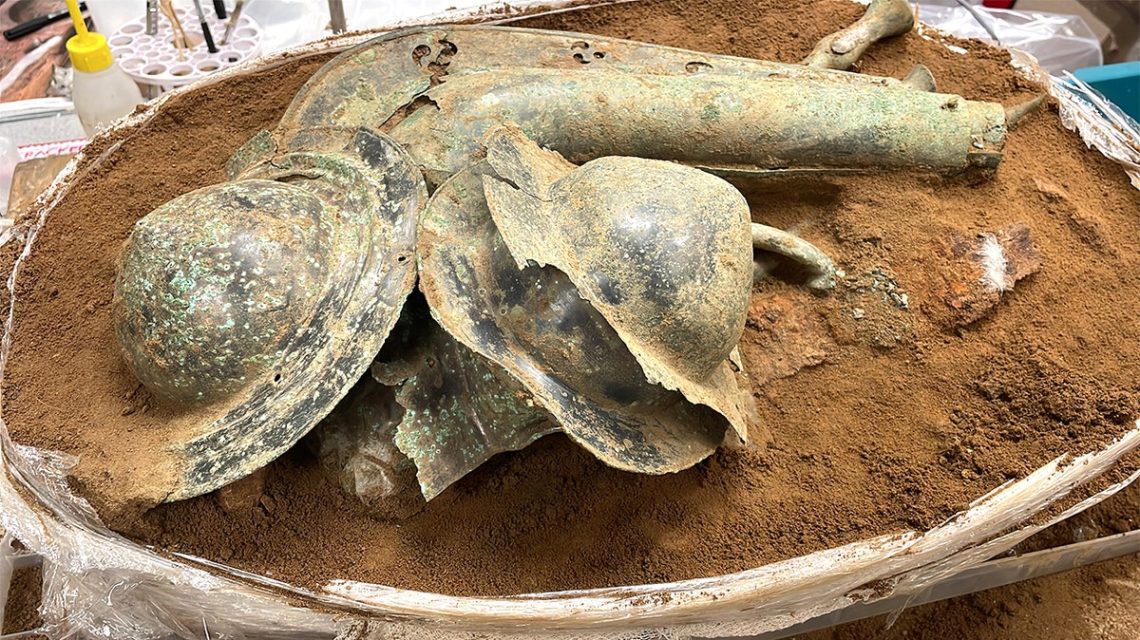
In an exciting discovery, archaeologists recently unearthed a remarkable artifact from ancient Britain—a Celtic battle trumpet known as a carnyx. This artifact possibly has connections to the legendary Queen Boudica’s tribe. Historic England announced in January that a routine archaeological excavation had uncovered a variety of Iron Age objects, with the standout piece being a nearly complete Iron Age battle trumpet. These trumpets were historically used to produce eerie sounds in battles, bolstering the morale of troops as they faced their adversaries.
The carnyx was discovered by archaeologists from Pre-Construct Archaeology in West Norfolk, located in the eastern region of England. Historic England’s announcement highlighted the significance of these animal-headed bronze instruments, which were used across Europe by Celtic tribes to motivate their warriors. Fascinated by these war trophies, the Romans often depicted them in their art.
This recent discovery is only the third known example of a Celtic carnyx in Britain, and it is among the most complete carnyces found in Europe. The site of the find, Norfolk, was once a hub for the ancient Iceni tribe, a Celtic group led by the famous warrior queen Boudica.
In the first century A.D., Boudica led a notable, though ultimately unsuccessful, revolt against the Roman Empire, which has etched her name into the annals of history as a symbol of Britannia’s spirit and resistance.
While the trumpet cannot be directly linked to Boudica herself, its discovery in the Iron Age landscape associated with the Iceni tribe maintains its relevance. Tim Pestell, Senior Curator of Archaeology at Norfolk Museums Service, described the find as a powerful reminder of Norfolk’s Iron Age heritage. The story of the Iceni people and Boudica’s legacy continues to capture the interest of the British public.
The Norfolk Carnyx Hoard presents an unparalleled opportunity for archaeologists to dive into ancient history, examining rare objects from the past and exploring the stories they tell about the forces that shaped Norfolk over 2,000 years ago.
Alongside the trumpet, the excavation team discovered a sheet-bronze boar’s head—an ornamental metal fitting—along with five shield bosses, which are protective domes used in shields to safeguard a fighter’s hand. Additionally, the team unearthed an iron object of uncertain purpose.
Following the initial surprise of their findings, the archaeologists followed best practices for excavation, recovering these rare and delicate artifacts meticulously. Not only are these finds significant within Britain, but also across Europe, highlighting their rarity and historical importance.
Conservation specialists at Norfolk Museums Service now painstakingly examine and stabilize these artifacts, which are in a fragile condition. Detailed research into these objects is set to begin once stabilization is complete. Currently, the legal status of the hoard awaits determination by the coroner, anticipated in early 2026. This decision will guide future actions related to the find.
Mark Hinman, Chief Executive of Pre-Construct Archaeology, expressed pride in the project’s outcomes, crediting his team for their diligence and expertise at this unexpected and special site. Although the artifacts aren’t directly associated with Boudica, their origin in the same ancient landscape linked to her tribe only adds to their allure.
This carnyx joins a series of Iron Age discoveries across Britain over the past year. For instance, last year saw Durham University archaeologists uncover what is considered one of the largest and most significant Iron Age hoards in the UK, featuring over 800 objects, including 28 chariot wheels.
 YouTuber Shares Difficult Decision After Trisomy 21 Diagnosis
  The Changing Dynamics of Celebrity Reputation in 2026
  Robbers Sentenced for Theft of Romanian Treasures from Dutch Museum
  YouTuber Sparks Debate Over Abortion Rights and Down Syndrome
  Celebrate America’s 250th Birthday with Commemorative Products
  Flesh-Eating Fly Returns to the United States Causing Concern