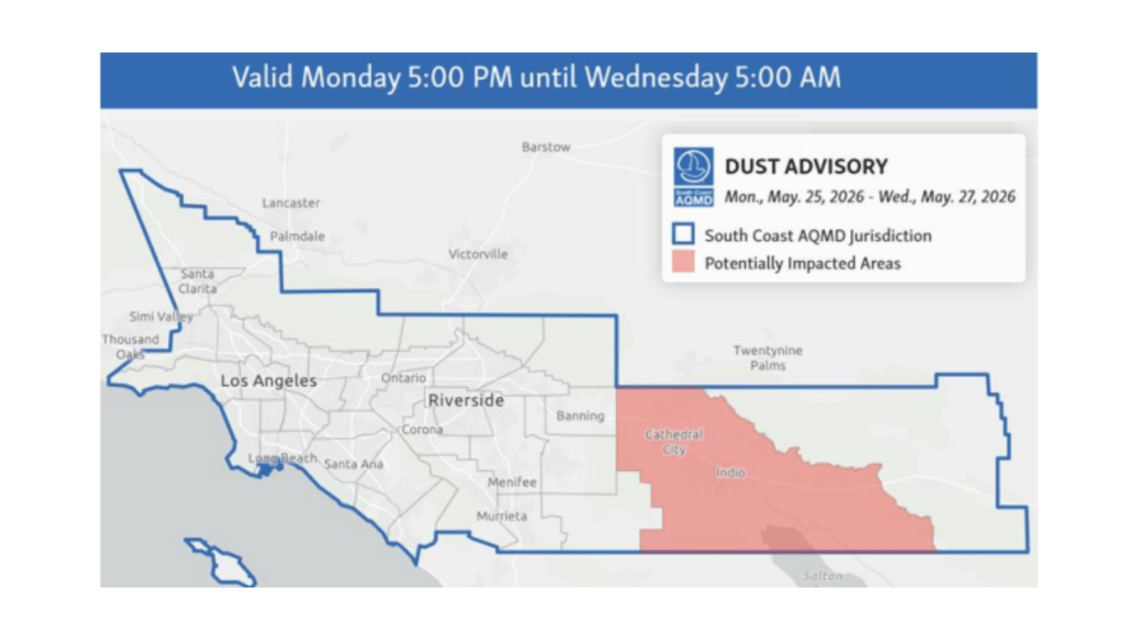
The National Weather Service (NWS) has advised thousands of Southern California residents to remain indoors and keep windows and doors shut as poor air quality, caused by windblown dust, affects the region.
Areas Affected
Air quality alerts have been issued across the Coachella Valley and Imperial Valley in southeastern California. In the Coachella Valley, including Palm Springs, Indio, Cathedral City, Palm Desert, and La Quinta, the South Coast Air Quality Management District (AQMD) released an advisory effective from Monday afternoon until early Wednesday morning.
Imperial County has also seen a separate alert for areas like El Centro, Calexico, Brawley, and Salton City, valid from Tuesday afternoon through to Wednesday night, as noted by the NWS. These warnings impact tens of thousands of people in Southern California’s desert regions, where air quality is expected to range between ‘unhealthy’ and ‘unhealthy for sensitive groups.’
Reasons for Poor Air Quality
The AQMD advisory attributes the decline in air quality to strong winds sweeping across dry desert areas, dispersing large dust quantities into the air. Forecasts suggest wind gusts up to 50 mph in parts of the Coachella Valley, fostering conditions for windblown dust and increased particulate matter (PM10). These tiny particles can remain airborne and spread extensively depending on weather conditions. Even brief high winds over exposed soil or agricultural areas can sharply raise pollution levels in desert regions like Imperial Valley.
Air quality is anticipated to fluctuate on Tuesday—and in some locales through Wednesday—with the worst conditions likely during windy intervals.
Health Risks of Particle Pollution (PM10)
Health authorities caution that particle pollution, especially PM10, poses significant health risks. Fine particles under 10 micrometers in diameter can deeply penetrate the lungs and enter the bloodstream, leading to serious health issues.
- Short-term exposure can cause asthma attacks, airway irritation, coughing, and breathing difficulties.
- Long-term or high-level exposure may result in heart attacks, irregular heartbeat, worsening chronic lung disease, and increased lung infection risk.
Children, older adults, and those with heart or lung conditions face the highest risk.
Protective Measures for Residents
Authorities recommend several protective actions as air quality declines:
- Stay indoors and keep windows and doors closed.
- Use air conditioning or air purifiers to filter indoor air.
- Avoid appliances that draw in outdoor air, like swamp coolers or whole-house fans.
- Limit or avoid outdoor exercise, especially during peak pollution times.
- Avoid creating additional indoor pollution by steering clear of candles, fireplaces, and gas-powered equipment.
Outlook for the Upcoming Days
The outlook for air quality depends largely on wind and dust conditions. In the Coachella Valley, officials expect gradual improvement after early Wednesday morning, though poor air quality may persist if winds remain strong. In Imperial County, the alert extends to Wednesday night, indicating possible lingering dust and unstable conditions through midweek.
Forecasters suggest that although winds might ease during parts of the day—potentially improving air quality temporarily—renewed gusts could rapidly degrade air quality again, maintaining unpredictability.
Key Takeaway
For the time being, officials recommend a simple approach: Limit exposure, stay informed, and maintain clean indoor air.
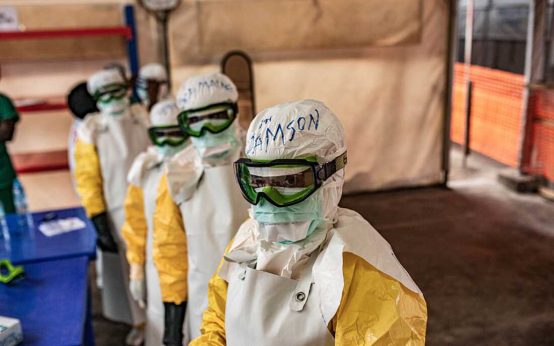 Ebola Outbreak in Africa: A Serious Concern
  Confronting the Truth Behind Sustainability Buzzwords in the Food Industry
  The Aftermath of Santa Rosa Island’s Fire
  Largest Seizure of Illegal Cockroaches in Australia
  Flesh-Eating Fly Returns to the United States Causing Concern
 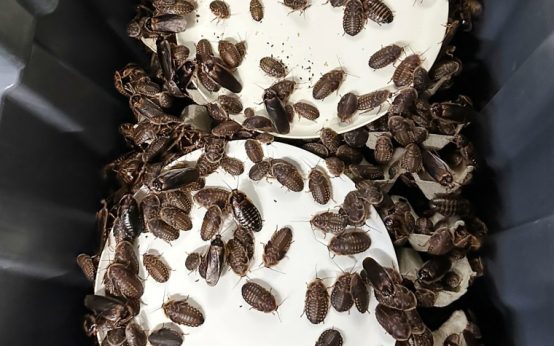 Australia’s Largest Seizure of Exotic Invertebrates: Over 100,000 Cockroaches Confiscated