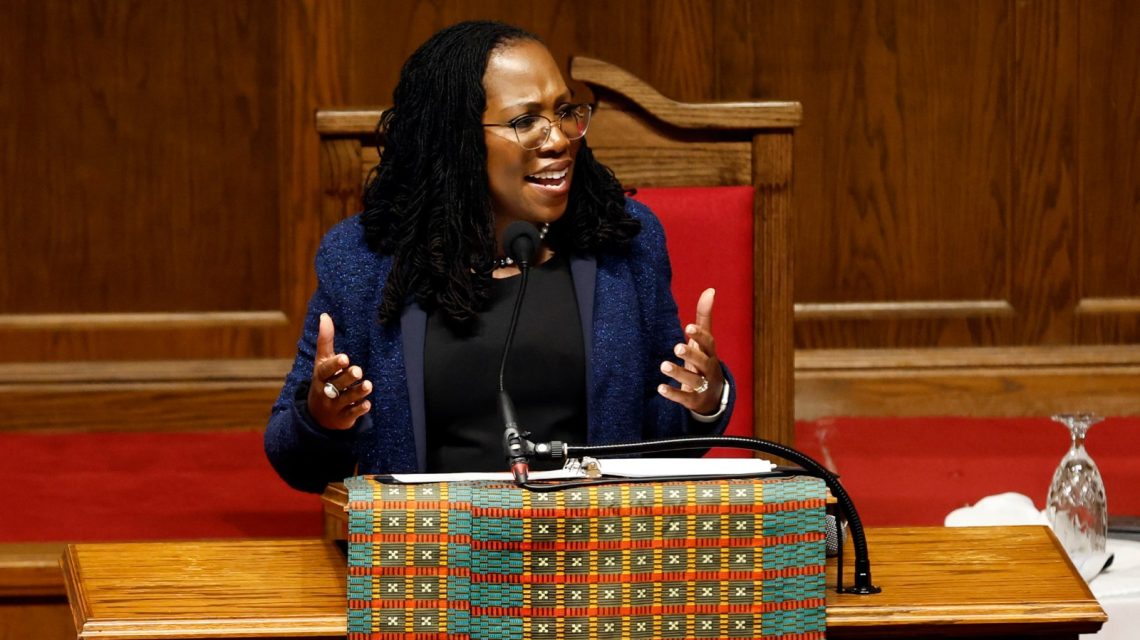
The Supreme Court on Thursday imposed limitations on how federal prisoners can seek early release, ruling that arguments claiming a conviction is invalid cannot be raised through the ‘compassionate release’ statute. Justice Ketanji Brown Jackson provided a strong dissent.
The Court’s Decision
Justice Jackson opposed the majority, which stated that challenges to the legality of a conviction must be pursued through the traditional habeas process under federal law, not through motions for sentence reductions citing ‘extraordinary and compelling reasons.’ The majority, led by Justice Amy Coney Barrett, emphasized that allowing such claims would let prisoners bypass strict procedural limits set by Congress.
Jackson, the lone dissenter, maintained the statute was intended as a flexible ‘safety valve’ for addressing unjust sentences. She argued the ruling might prevent legitimate claims from being heard. ‘The Court arbitrarily restricts that discretion,’ she wrote, criticizing the majority for creating a rule barring courts from considering claims questioning a conviction.
Case Background: Joe Fernandez
The case involved Joe Fernandez, serving a life sentence for murder-for-hire in the Bronx, New York City, since 2000. Sentenced in 2013, Fernandez has repeatedly challenged his sentence. A trial judge, citing concerns about the reliability of key testimony, initially granted his release on compassionate grounds. The Supreme Court’s decision reverses that outcome, reinforcing the separation between legal challenges and sentence-reduction mechanisms typically reserved for factors such as illness or age.
Perspective of the Majority
The conservative majority, led by Barrett, asserted that federal prisoners cannot use compassionate release motions to challenge their convictions’ validity. They emphasized that such claims must follow the traditional habeas process, specifically designed for post-conviction challenges. They warned against repackaging conviction challenges as requests for sentence reduction, which sidestep habeas rules, potentially undermining strict deadlines and limits on repeat filings.
The Court noted that allowing conviction-related claims through compassionate release might lead to unlimited relitigation long after cases become final.
Sotomayor and Kagan’s Viewpoint
Justice Sonia Sotomayor, with Justice Elena Kagan, agreed to reverse the lower court’s decision to release Fernandez but dismissed the majority’s broader legal reasoning. In a concurring opinion, Sotomayor argued that the Court imposed an excessive limit on compassionate release not supported by the statute itself, potentially blocking legitimate claims overlapping with conviction arguments.
Sotomayor proposed evaluating whether new circumstances emerged since sentencing as the framework for compassionate release. She emphasized it should address post-sentencing developments making imprisonment unjust, not relitigate issues previously determined.
Sotomayor concluded that Fernandez failed to present new evidence or material changes, thus, relief was not warranted. Witness credibility and prosecution weaknesses had been litigated during trial and appeals.
Broader Implications and Justice Jackson’s Concerns
Jackson warned about potential broader consequences, especially in cases suggesting innocence. She advocated retaining court discretion in extreme situations, particularly when new evidence challenges guilt. Jackson believed the majority undermined the compassionate-release tool intended by Congress for ‘just treatment of defendants.’ She stressed potential difficulty distinguishing proper claims for compassionate release from habeas claims.
‘The majority ignores this problem rather than seeing the habeas-based limitation as an ill fit for distinct compassionate-release evaluation,’ Jackson wrote.
Fernandez remains in prison on the murder-for-hire conviction following the ruling.
 Ex-CIA Official Detained Over Possession of Gold Bars Worth $40 Million
  High Tensions Escalate in Texas Teen’s Murder Trial
  Acquitted Woman Sues Massachusetts Police Over Alleged Misconduct
  Autopsy Reports of University of Idaho Victims Unsealed
  Legal Battle Over Ryne Sandberg’s Trust
  Karen Read Files Lawsuit Against Massachusetts State Police and Canton