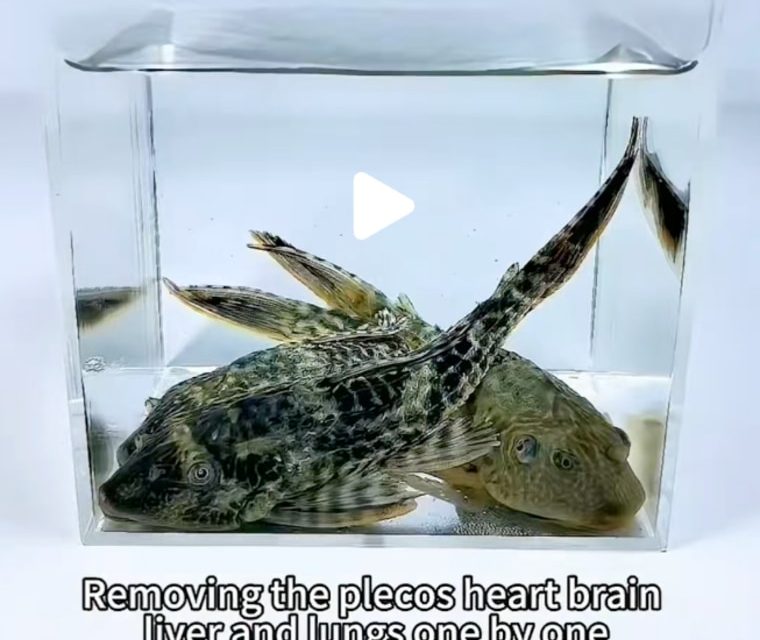
Recently, social media platforms have seen a surge in ‘LabGerm’ videos. These often begin with gloved hands set against a white background, as an AI voice narrates with upbeat music playing. In these videos, fish and other small animals endure distressing ‘experiments.’ Some clips seem to be AI-generated, while others supposedly show real animals in pain. The absence of a clear conclusion or purpose suggests that the shocking content itself is the main focus.
These videos, spread across TikTok, Instagram, and Facebook, originate from Chinese social media and have garnered millions of views. They exploit a phenomenon known as ‘rage bait,’ where controversial content incites public outrage, ultimately boosting its reach. This trend has birthed a niche of reaction videos, discussions, memes, and even merchandise around the term ‘LabGerm.’
An NBC News investigation revealed that many of these videos, where small animals like pleco fish, leeches, snails, and insects suffer, began on the Chinese app Douyin. At least 49 accounts promoting such content have been identified on the platform. Despite TikTok removing three accounts violating community guidelines, over 20 similar imitators remained on the platform as of mid-May. Such content continues to circulate on YouTube and Meta platforms as well.
This situation underscores the ongoing struggle to regulate objectionable content on the internet. Engagement, whether positive or negative, drives the spread of these videos. Nicola O’Brien, from the Social Media Animal Cruelty Coalition, highlights the cycle of outrage where people create content reacting to the original, unintentionally amplifying it further.
This recent wave of animal abuse videos echoes past trends involving monkeys, cats, and dogs. However, unlike earlier instances confined to darker internet regions, pleco fish videos are widely accessible. Content intended to shock and disgust has long existed online, but modern social media has created new incentives and distribution mechanisms for its spread.
Social media platforms, with their vast user bases, face significant challenges in moderating content effectively, even with automated systems. This allows many distressing videos to slip through cracks. While platforms have become more proactive in policing content, the desire for views and engagement persists, complicating efforts to curb the spread of harmful videos.
TikTok’s spokesperson, responding to NBC News, noted that accounts flagged for spreading such videos were deleted. The platform’s community guidelines strictly prohibit animal cruelty. Users can report policy-violating content through the app or a web form.
Meta did not provide a statement regarding the issue. It’s unclear who is behind the production and dissemination of these videos or their reasons for sharing them. The path these videos took from Douyin, a platform restricted to certain Chinese regions, to TikTok and Meta, remains uncertain. Douyin’s parent company, ByteDance, stated that videos promoting animal abuse are against their policies. Despite this, videos sent to Douyin for review were still available as of May.
Before its deletion, the main ‘LabGerm’ account had claimed it would stop sharing pleco fish content, fearing account removal. Users quickly responded by creating anthropomorphic memes and related content, blaming others instead of the creators.
The primary focus of these videos is the pleco fish, a species favored by aquarium enthusiasts for its algae-cleaning capabilities. Some videos justify abuse by labeling the pleco as invasive. The species hasn’t garnered much public concern, which might explain why the content persists without moderation.
Nicola O’Brien notes that fish aren’t widely recognized as sentient beings capable of suffering like mammals. This perception could contribute to the continued availability of fish torture videos on various platforms despite their harmful nature.
Peter Li, an animal policy professor at the University of Houston, has monitored these videos for months. Initially perceived as a fleeting trend, these videos have persisted, partly driven by AI content creation.
Under some videos on Douyin and TikTok, commenters request specific ‘experiments’ on the fish, describing them as ‘volunteers.’ Li observes that creators use real footage when possible, blending AI elements when necessary. China’s lack of nationwide animal cruelty laws complicates prosecuting those behind such content.
Although some platforms take action against these videos, the flow of fish torture content continues. Li explains the societal bias where animals like fish are considered less deserving of empathy compared to cats and dogs.
 60 Minutes Correspondents Decide to Stay Amid Crisis
  AI Impact: How AI Search is Transforming Professional Services and IT Budgets
  The Critical Role of Magnets in Modern Drone Warfare
  Flesh-Eating Fly Returns to the United States Causing Concern
  Australia’s Largest Seizure of Exotic Invertebrates: Over 100,000 Cockroaches Confiscated
  Gene Editing in Human Embryos at Columbia University