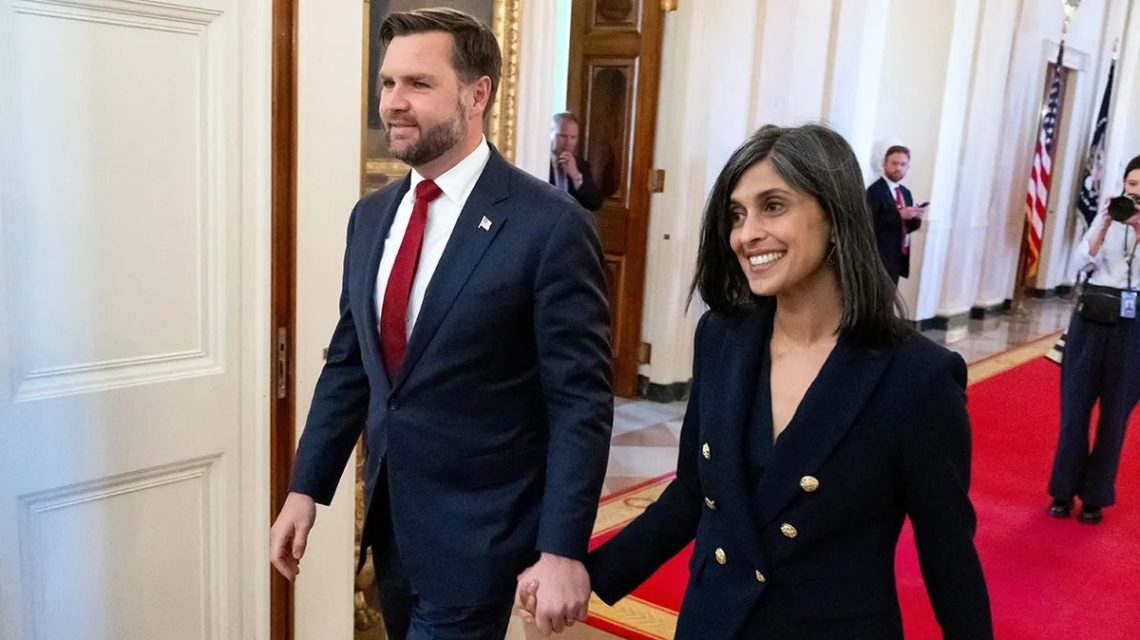
The announcement from Second Lady Usha Vance about expecting her fourth child brings a refreshing and joyful update to the landscape, where having four children is quite rare nowadays. Across the United States, there is a noticeable trend of women opting to have fewer children, or sometimes none at all. Speaking from personal experience as a parent, I find inspiration in Vance’s announcement and hope it might encourage more women to consider similar paths.
Deciding to have children is often viewed as an individual’s lifestyle choice. However, this decision extends beyond personal dimensions and holds significant implications for the broader nation. A stable birth rate is crucial for maintaining a country’s economic stability, cultural vibrancy, and population growth.
“Without enough births to maintain its population, a country struggles to sustain its economy, communities, and culture.”
An illustrative example is currently unfolding in Britain, which is grappling with a significant demographic crisis where deaths are beginning to surpass births. Many educated and financially secure women in Britain are intentionally choosing not to have children. One woman shared in The Free Press story, “It’s not that I don’t have reasons. It’s that I have too many. If you knocked one down, I’d just give you ten more.”
The United States is witnessing a similar downward trend in its birth rate, a pattern that has persisted for over a decade, dropping below the replacement level. This scenario reflects challenges faced by other countries as well.
Several reasons behind women’s reluctance to embrace motherhood include the high costs associated with raising children and the career demands that coincide with prime fertility years. Furthermore, societal norms often regard motherhood as a hurdle in professional life instead of as a societal contribution.
However, another less-discussed factor is influencing decisions about motherhood: challenges in finding partners ready to commit to starting a family. Modern dating dynamics, compounded by the prevalent consumption of pornography among men, are altering perceptions and expectations around relationships. Data from Barna Group indicates that 78% of men aged 13 to 65 in the U.S. consume pornography, which poses significant implications for emotional and relational development.
“A culture that normalizes constant sexual consumption trains men to expect gratification without sacrifice. Pornography promises connection but delivers isolation.”
These changing dynamics contribute to a society increasingly isolated from marriage, family, and authentic intimacy, resulting in fewer marriages and family formations. A culture overwhelmingly exposed to pornographic consumption often leads to negative outcomes not only for women but society as a whole.
Marriage isn’t disappearing because women are losing interest but rather because men often veer away from the path of commitment. Many men find themselves living disconnected lives, heavily reliant on online interactions, and under the misconception that significant financial resources are prerequisites for starting a family.
Contrary to being an act of ambition or selfishness, women’s avoidance of motherhood often stems from a rational response to a dating environment lacking emotional stability, fidelity, and long-term accountability.
The nation needs strong men to turn away from pornography and focus on family building, leaving meaningful legacies. At the same time, it would benefit if women discard the notion that conditions must be ‘perfect’ to embark on motherhood. Fertility doesn’t wait for the perfect time.
Despite the significance of economic factors, they alone cannot fully account for current trends. Even countries with robust family-support systems, like paid leave and subsidized childcare, see birth rates fall below replacement levels when marriage and societal meaning weaken.
Both career success and education are important, but they shouldn’t replace the roles of family, meaningful relationships, or legacy. When children are seen as optional, a society inevitably faces labor shortages and issues with economic stability.
Ultimately, what’s lacking is a collective belief in the value of marriage, motherhood, and fatherhood, which is essential to societal growth.
Historically, past generations have faced times of war, economic downturns, and societal changes, yet still chose to raise families because they believed in the future. When a society stops believing, it also stops having children.
America stands at a critical juncture, with the option to either rebuild a culture that venerates marriage, upholds motherhood, and encourages men to honor responsibilities or accept a decline and call it progress. Children’s roles are central to cultural continuity, as exemplified by Second Lady Vance’s stance.
Penny Nance serves as CEO and president of Concerned Women for America, the nation’s largest women’s public policy organization.
 NASCAR Community Mourns the Loss of Kyle Busch
  Persistence in Investigations: Encouragement and Challenges
  Support Pours in for Airport Worker After Viral Video
  Challenges of Reentry After Years in Prison
  YouTuber Sparks Debate Over Abortion Rights and Down Syndrome
  Significant Events in Chicago on June 5