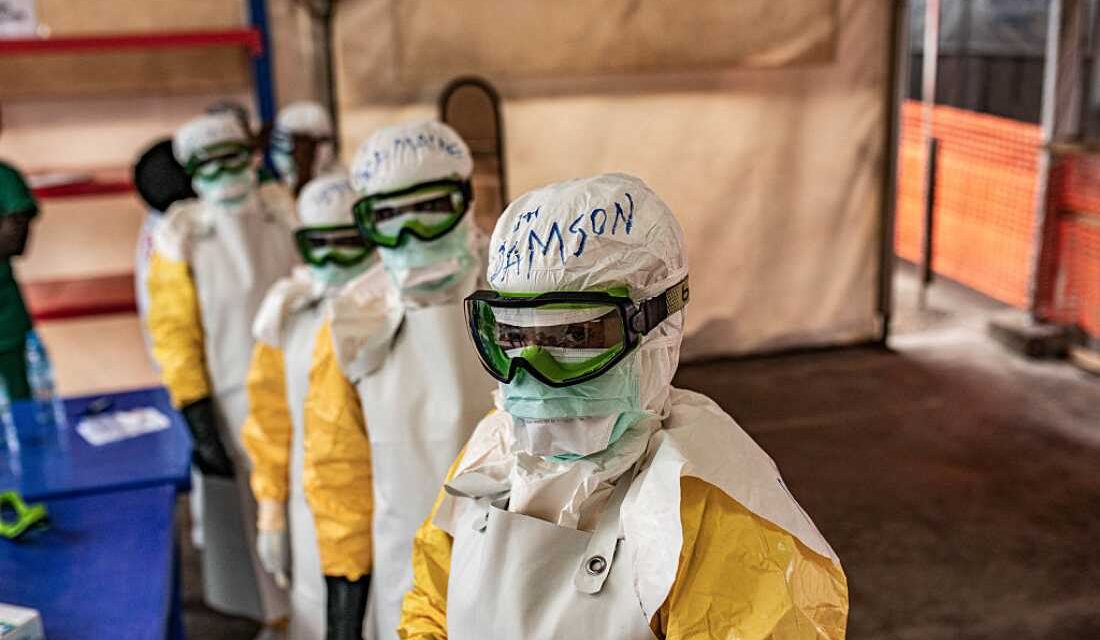
Health workers don significant protective gear at an Ebola treatment center in Monigi, Democratic Republic of Congo, as a new outbreak emerges. The outbreak’s potential severity mirrors that of the West Africa epidemic from a decade ago. Back then, the virus resulted in 28,000 cases. Current predictions suggest that the situation could become equally dire, with the potential for more than 20,000 cases and at least 4,000 deaths in the next three months.
The U.S. Centers for Disease Control and Prevention (CDC) has released new analyses that underscore the urgent need for rapid intervention. Both the Democratic Republic of Congo and Uganda are actively working to control this rapidly expanding crisis. These efforts have prompted the World Health Organization to declare an international health emergency.
The CDC emphasized the need for quick and effective public health responses. According to projections, if only 20% of Ebola cases are isolated within two days of symptom onset, over 20,000 cases could develop in most scenarios. Isolation measures are crucial in containing the epidemic. Jason Asher, from the CDC’s Center for Forecasting and Outbreak Analytics, reiterated this at a recent briefing. The key is to increase the number of people entering isolation promptly after exposure.
If 70% of cases are isolated within two days, there’s a 94% chance to cap cases under 10,000 in the next three months.
This statement from Asher highlights the critical nature of timely intervention. Jennifer Nuzzo, from Brown University’s School of Public Health, echoed these concerns, acknowledging that this outbreak is heading down a dangerous path unless stronger measures are imposed.
In terms of global risk, the CDC’s assessments indicate that the U.S. remains at low risk, thanks to its preparedness to quickly identify and isolate cases. The disease does not spread as easily as other viruses like COVID-19. Satish Pillai, the CDC Ebola response incident manager, advises that there’s no cause for widespread concern in the U.S. outside of travel to directly affected regions, such as the Democratic Republic of Congo or Uganda.
Despite the alarming situation, it is not too late to act decisively and efficiently. The CDC, backed by its past experience in handling Ebola outbreaks, focuses on containment and control in the affected regions. Anthony Banbury, a former U.N. official with extensive involvement in past Ebola responses, stresses the need for a well-coordinated global effort to avert further escalation.
 Mount Sinai Health System Faces Subpoena on Gender-related Care
  Potential Ebola Outbreak in Central Africa Raises Concerns of Rapid Spread
  Researchers Escorted Out of Diabetes Conference for Criticizing Trump Administration
  Gold and the Ebola Outbreak in Congo’s Mining Towns
  House Passes Bill for Veterans’ Benefit Increase
  Gene Editing in Human Embryos at Columbia University