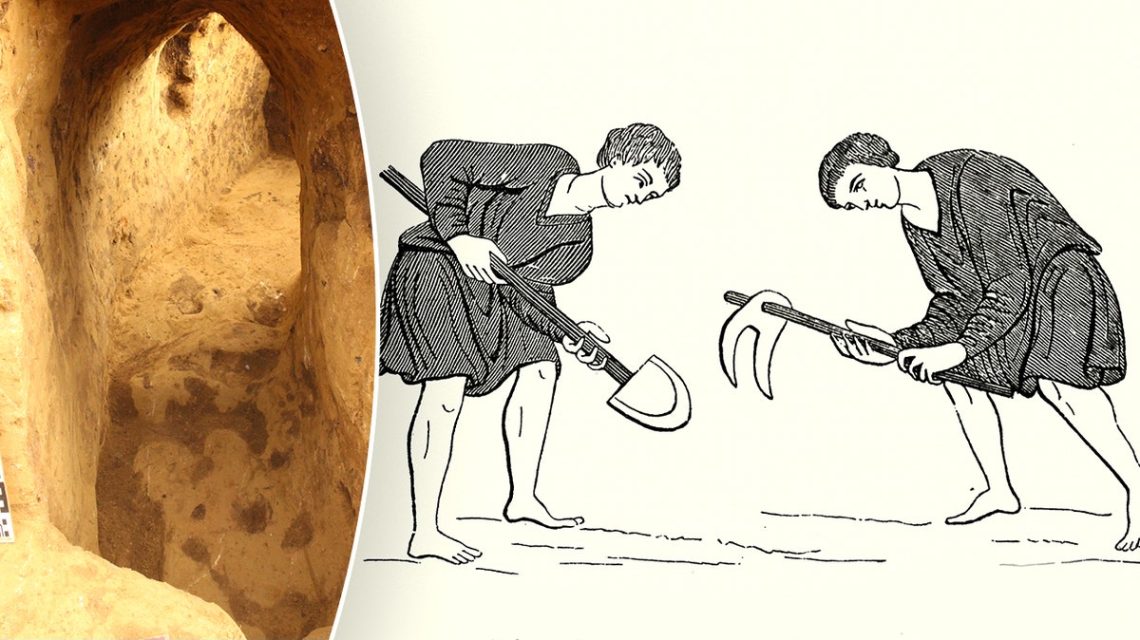
Recent archaeological discoveries in Germany have unearthed a fascinating secret from the Middle Ages: a hidden tunnel within a much older burial site. This discovery was announced in a press release on January 29 by the State Office for Heritage Management and Archaeology of Saxony-Anhalt (LDA Saxony-Anhalt).
The tunnel was located within a Middle Neolithic burial complex near Reinstedt, Germany. Experts believe that members of the Baalberge culture utilized this burial site as far back as the 4th millennium B.C.
The Tunnel Discovery
Late last year, archaeologists came across this intriguing find during preparatory work for wind turbine installations. Concealed within the loess, which is compact wind-deposited silt, the underground tunnel, or erdstall, was constructed approximately 5,000 years after the burial site in the late Middle Ages. However, archaeologists remain unsure of its purpose, which might have ranged from serving as a hiding place to being used for cultic activities, according to their interpretations.
Initial inspections led the team to believe that they had discovered a grave. The excavation team found a trapezoidal ditch with poorly preserved remains believed to be from the Late Neolithic period of the 3rd millennium B.C. A stone slab at the northern end of the pit further fueled their assumption that it was a grave. But upon further investigation, the true nature of the site as an underground tunnel was unveiled.
Exploring the Erdstall
As they ventured deeper into the loess beneath the ancient site, archaeologists found late medieval pottery, stones, and small cavities, confirming the structure as an erdstall. Among the artifacts discovered were a horseshoe, traces of a short-lived fire indicated by charcoal remnants, and animal remains. These findings, paired with the Neolithic ditch’s visibility above ground during medieval times, suggested that the tunnel might have been purposefully constructed there.
One of the most intriguing discoveries was an accumulation of larger stones stacked at the entrance, hinting at an intentional sealing of the passage. This added a layer of mystery to the site, suggesting that its creators may have had reasons to prevent others from accessing it.
Preserving History
The uncovering of this tunnel is part of a broader array of recent archaeological successes in Germany. Over the past summer, archaeologists found a Roman-era settlement along with ancient building remnants and artifacts in North Rhine-Westphalia. Additionally, an excavation near a Northern German inlet revealed early medieval treasures, including a rare cross.
 Flesh-Eating Fly Returns to the United States Causing Concern
  Australia’s Largest Seizure of Exotic Invertebrates: Over 100,000 Cockroaches Confiscated
  Gene Editing in Human Embryos at Columbia University
  NASA Declares MAVEN Spacecraft Dead After a Decade of Mars Observations
  WHO Reports Reduction in Suspected Ebola Cases in Central Africa
  Ancient Tunnel Discovery Near Jerusalem’s Ramat Rachel