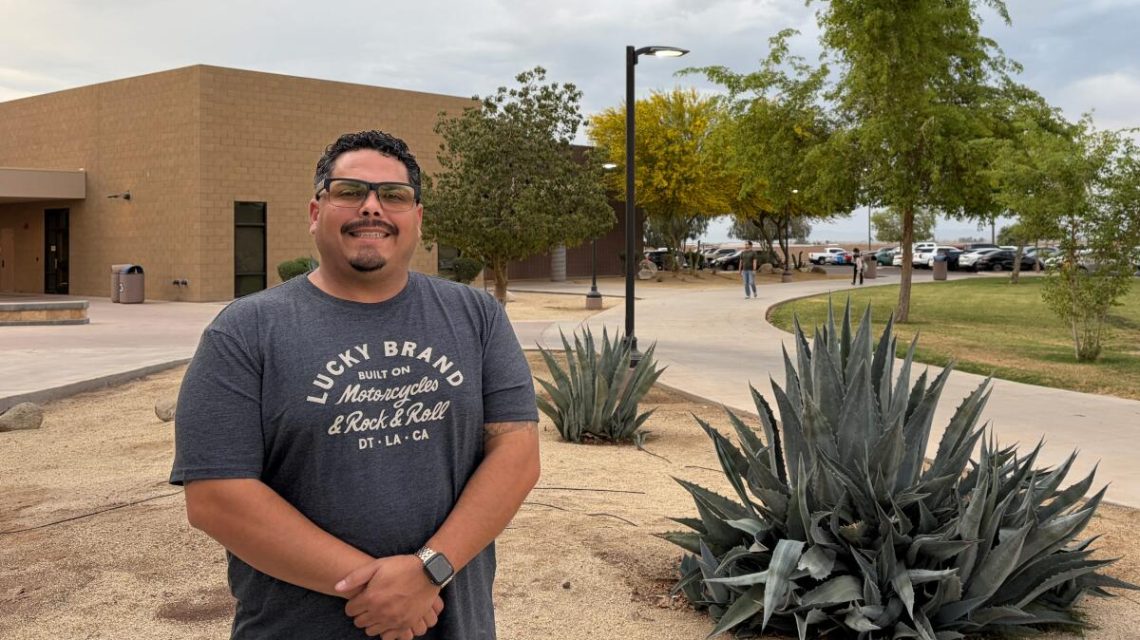
When Imperial Valley College unveiled a program to train students as plant operators and technicians for the budding lithium industry, Corban Dillon was among the first to join, seeking a career in a promising field. However, after earning his certificate in spring 2024, the anticipated lithium-related jobs were not available. Dillon enrolled in two more programs related to the lithium industry, but job opportunities in lithium extraction—a crucial component in batteries that power clean energy—remained limited.
Dillon, who is 41, explained, “A lot of us have jobs or families to support while pursuing certifications. Without immediate job prospects, it’s challenging to commit to continuing education.”
This situation illustrates a dilemma facing community colleges when an emerging industry is expected to take root. Residents want the jobs, and companies express interest in hiring locals—if they acquire the necessary skills. Institutions like Imperial Valley College must decide the right time to launch programs to equip students with the skills needed for future jobs, before these roles are filled by skilled workers from other areas.
Imperial Valley College has temporarily scaled back its lithium programs due to job market uncertainty, serving as a case study on the challenges of preparing students for new fields. Betony Jones, a senior researcher at UC Berkeley Labor Center’s green economy program, noted similar challenges in other sectors like solar and advanced manufacturing. These fields often require additional postsecondary training.
“Calibrating the timing is crucial. Employers can’t start training workers only when needed,” Jones emphasized. “But workers can’t train and then wait indefinitely.”
In Imperial County, an area heavily reliant on agriculture and suffering high poverty rates, the stakes are especially high. In March, the county’s unemployment rate reached 16.9%, significantly higher than neighboring regions.
Priscilla Lopez, the Director of Workforce and Economic Development for the county, stated, “The current local mentality is moving to find a viable future and secure employment elsewhere. Local job opportunities could change that outlook, offering hope within the valley.”
A decade ago, companies began showing interest in the area’s lithium reserves. Dubbed “Lithium Valley,” the region became a focal point for potential job creation when Berkshire Hathaway Energy Renewables announced plans to pursue commercial operations by 2026. Despite these announcements, progress has been slower than expected. BHE Renewables has only recently completed its demonstration plant. Controlled Thermal Resources, another active company, is still in fundraising stages, with job opportunities predicted to be at least two years away.
Lithium batteries offer a prevailing solution for storing wind and solar energy and powering electric vehicles. An estimated 18 million metric tons of lithium carbonate reside beneath the Salton Sea, theoretically capable of powering 375 million electric car batteries.
The prospect of a lithium boom prompted calls for expanded educational offerings in the Imperial Valley. The region’s leading higher education institutions, Imperial Valley College and a San Diego State University satellite campus, acted swiftly. San Diego State tapped into $80 million in state funding to construct a new STEM campus focusing on science, technology, engineering, and mathematics.
New undergraduate degree programs in electrical engineering and chemistry aim to support local industry demands in geothermal and lithium sectors, according to John McMillan, the university’s assistant vice president for economic development.
Imperial Valley College received funding from the U.S. Department of Energy for its Lithium Industry Force Training program. The courses—covering chemistry, mathematics, hazardous materials training, and plant operations—provide pathways to certification as a plant operator, chemical lab technician, or instrumentation technician.
The college promotes the certification programs as a swift entry into the lithium industry. “Are you ready to launch your career in the burgeoning lithium industry? Imperial Valley College’s new chemical lab technician certificate program is your ticket,” declares a promotional video voiceover for the program.
Locals eager for stable, nearby jobs responded enthusiastically. For some, such as George Prieto, the opportunity presents a first step into higher education. Prieto, aged 48, currently interning at a local water and power utility, previously worked in retail merchandising and as a weekend DJ.
“Usually, jobs attract global talent, but this program offers local residents a chance,” Prieto stated. “We don’t have to move elsewhere for work.”
Industry representatives and county officials attribute the delayed timelines to a 2024 lawsuit by environmental groups and shifting political and market dynamics. The lawsuit contends that the project underestimated potential environmental impacts like water pollution or health risks. The case remains under appeal.
Notably, the previous administration’s discontinuation of electric vehicle incentives and the redirection of federal attention towards lithium projects in other states, like Arkansas and Nevada, have resulted in significant changes.
Recently, near the Salton Sea, one of the key lithium-driven companies redirected efforts toward data center development. In late 2024, a California Energy Commission member warned locals that “the Lithium Valley is not assured,” given federal funds going elsewhere.
In August of the prior year, San Diego State President Adela de la Torre conveyed concern, indicating that without expedited progress, local graduates from programs risk encountering an empty job market.
McMillan from San Diego State reaffirmed, “While timing remains outside our control, the university provides foundational education in engineering and chemistry that extends effectiveness across industries.”
As Imperial Valley College gears up for its third graduating class of industry-trained students, Lennor Johnson, leading the Imperial Community College District, noted, “We originally planned to launch these programs in sync with full-scale industry operations.” As of now, Johnson reported, 173 students have participated in certification programs since fall 2023, with 42 completions and 57 current enrollees.
By fall 2025, 16 students had secured jobs pertinent to their certificates. The college has scaled down cohorts and plans to pause two certificate offerings, resuming upon alignment with industry timelines.
Despite uncertainty, participants like Prieto see potential future utility for their credentials. Dillon remains optimistic, believing the vast lithium reserves will eventually bolster the industry. Recently, Dillon began full-time work with a mining company outside the county, benefiting from solid remuneration, perks, and a company car.
 Ukraine Strikes Moscow Oil Refinery in Drone Attack
  Cornell Student Sparks Outrage with Antisemitic Remarks
  The Rookery Building: A Testament to the Birth of Modern Skyscrapers
  Reflecting Pool’s Algal Bloom Returns After Renovation
  SWALCO’s Success in Waste Recycling
  Preservation Groups Challenge Statuary Garden Project