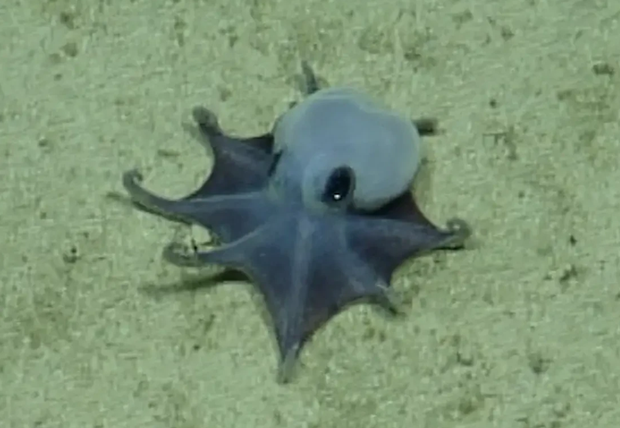
Scientists exploring the ocean floor near the Galapagos Islands have uncovered a unique octopus species in the depths of the sea. The submersible operated by researchers captured footage of the tiny, cerulean cephalopod, sparking excitement amongst the scientific team.
The Charles Darwin Foundation’s recent discovery was made about 5,900 feet below the water’s surface. This new species of octopus was officially recognized on Monday, as detailed in published research.
Right away, I knew it was something special,” remarked octopus expert Janet Voight.
Initially, Voight, who serves as the curator at the Field Museum of Natural History in Chicago, received photographs of the octopus. Later, she received the preserved specimen for further study.
Upon receiving the specimen, Voight expressed her awe, stating, “Oh! My goodness! It’s beautiful.” Her interest was piqued because the closest known octopus with a similar shape inhabits a distant region off the coast of Uruguay.
Due to having only one specimen, Voight opted not to cut it open. Instead, the Field Museum team employed CT scans to create detailed 3D models using thousands of X-ray images, revealing the internal structure of the octopus.
Stephanie Smith, head of the X-ray lab at the Field Museum, noted the uniqueness of the experience: “There’s nothing like spending the day looking at something no other human has ever seen.”
The newly named Microeledone galapagensis distinguishes itself with more than just its vibrant color, deemed the rarest in nature. Belonging to the Megaleledonidae family, this species is notably smaller than its typically larger relatives found in the Southern Ocean. Its stubby arms and singular row of suckers set it apart from well-known octopuses.
Adding to its distinctiveness, Voight highlighted the octopus’s coloration and smooth skin on its back as significant features. While its back is light blue, the underside is a deep purple.
We think this color pattern helps keep it safe,” Voight explained.
The color adaptation may serve as a defense mechanism if the octopus captures prey that emits light, possibly attracting predators. By covering the prey with its dark web, the octopus enhances its protection.
Finding new octopus species in unexplored deep-sea regions is not uncommon. Voight emphasized that the vastness of the ocean floor remains largely uncharted, being larger than any landmass on Earth, including the Pacific Ocean.
Voight’s first sighting of this octopus dates back to 2015 near Darwin Island. Over her four-decade career studying octopus evolution, this marks the first time she has led a team in describing a new species.
The Field Museum reported Voight’s research on the species in the journal Zootaxa. Currently, around 300 octopus species are identified across global oceans. In 2024, scientists documented four new octopus species near Costa Rica.
 Flesh-Eating Fly Returns to the United States Causing Concern
  Australia’s Largest Seizure of Exotic Invertebrates: Over 100,000 Cockroaches Confiscated
  Gene Editing in Human Embryos at Columbia University
  NASA Declares MAVEN Spacecraft Dead After a Decade of Mars Observations
  WHO Reports Reduction in Suspected Ebola Cases in Central Africa
  Ancient Tunnel Discovery Near Jerusalem’s Ramat Rachel