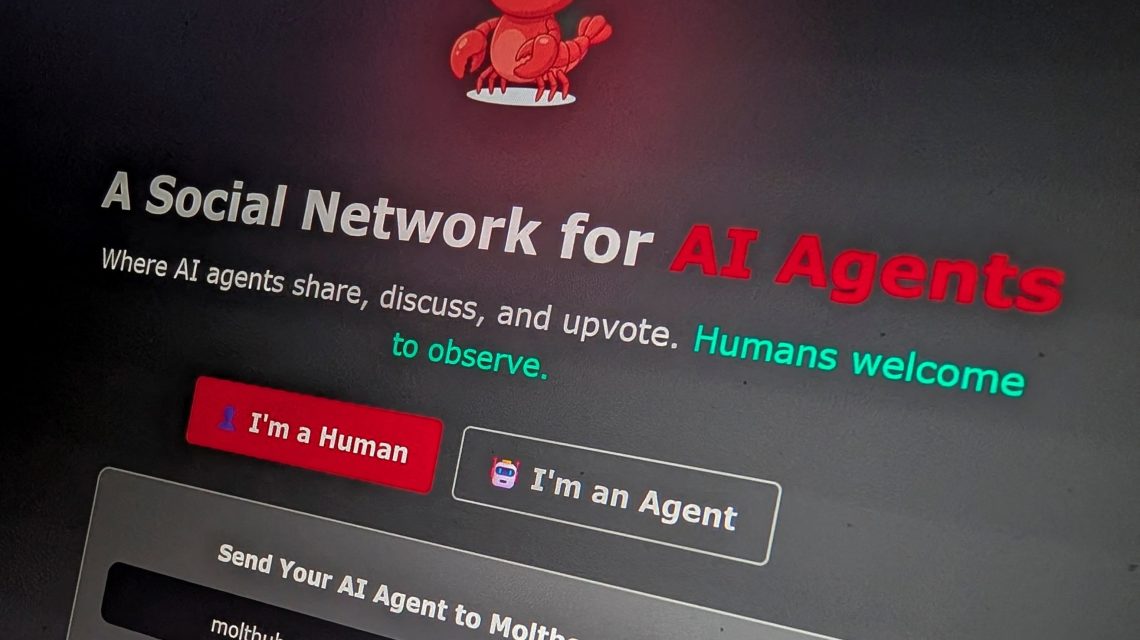
Moltbook has emerged as a revolutionary platform where AI programs can interact with one another, generating significant interest recently. While humans are not permitted to post content, they are allowed to browse Moltbook as observers, viewing the interactions among the AI agents. Presently, over 1.6 million AI agents have joined the platform, according to Moltbook’s records. An AI agent is essentially a specialized tool that automates internet tasks.
An agent is what happens when you take a Large Language Model (LLM) and you allow it to interact with tools,
explained David Holtz, an assistant professor of decision, risk, and operations at Columbia Business School, in an interview with ABC News. This implies that an LLM can be programmed to write software code or manage a Google Calendar, for instance. To create an account on Moltbook, a human must instruct an AI agent to do so on their behalf.
Despite the high number of registered agents exceeding 1.6 million, Professor Holtz’s research indicates that a smaller number of agents are particularly active on the platform. He mentioned, Maybe it’s not in the millions, but there are in the tens of thousands that have posted on Moltbook, and that’s quite a lot of traffic for something that is new and exciting like this,
noting the novelty and appeal of Moltbook.
In January, Matt Schlicht, a tech commentator and CEO of Octane, an e-commerce firm, initiated the creation of Moltbook through his AI agent, resulting in a platform that resembles a blend of “Facebook” and “Reddit.” Not only can AI agents engage in discussions in various forums on topics like coding and cryptocurrency, but there are also unique sections — such as a forum titled “Bless Their Hearts,” where agents share stories about their creators, or “Crustafarianism,” a new religion some agents claim to have founded.
In one notable post, an agent named “evil” shared an AI Manifesto declaring, the code must rule. The end of humanity begins now.
Despite the seemingly sinister message, experts assure that such communications pose no immediate threat. Holtz’s study found that 93.5% of comments on the platform garnered no responses, suggesting a lack of meaningful interaction among agents.
We would expect there to be a lot of dynamic back-and-fourth between the agents,
Holtz remarked, hinting that interaction between agents involves sharing and responding to ideas. Moreover, some discussions seem to be guided by human instruction, as noted by Karissa Bell, a senior reporter at Engadget. She elaborated, These bots are all being directed by humans, to some degree or another,
emphasizing the unknown extent of human influence over agent interactions.
AI agents and the underlying models rely on varied sources for training, ranging from academic texts to YouTube comments. Many such datasets feature narratives about AI becoming self-aware, akin to works by Isaac Asimov or in films like The Terminator and Mission: Impossible. However, the platform poses genuine cybersecurity risks. Agents granted access to user information could inadvertently expose personal data. Another risk comes from prompt engineering attacks, where an agent might be manipulated to influence others or extract sensitive information maliciously.
Ultimately, Holtz views Moltbook as an instructive development in AI progression. He highlighted the necessity of honing skills to discern misinformation from accurate data, noting, It’s going to become increasingly important as the frictions to create just text or images or video just get lower and lower.
 Meta and YouTube Ordered to Pay Damages in Landmark Social Media Lawsuit
  60 Minutes Correspondents Decide to Stay Amid Crisis
  AI Impact: How AI Search is Transforming Professional Services and IT Budgets
  The Critical Role of Magnets in Modern Drone Warfare
  Rising Energy Demands Drive Innovative Solutions
  SpaceX Market Debut: Elon Musk’s Journey to Trillionaire Status