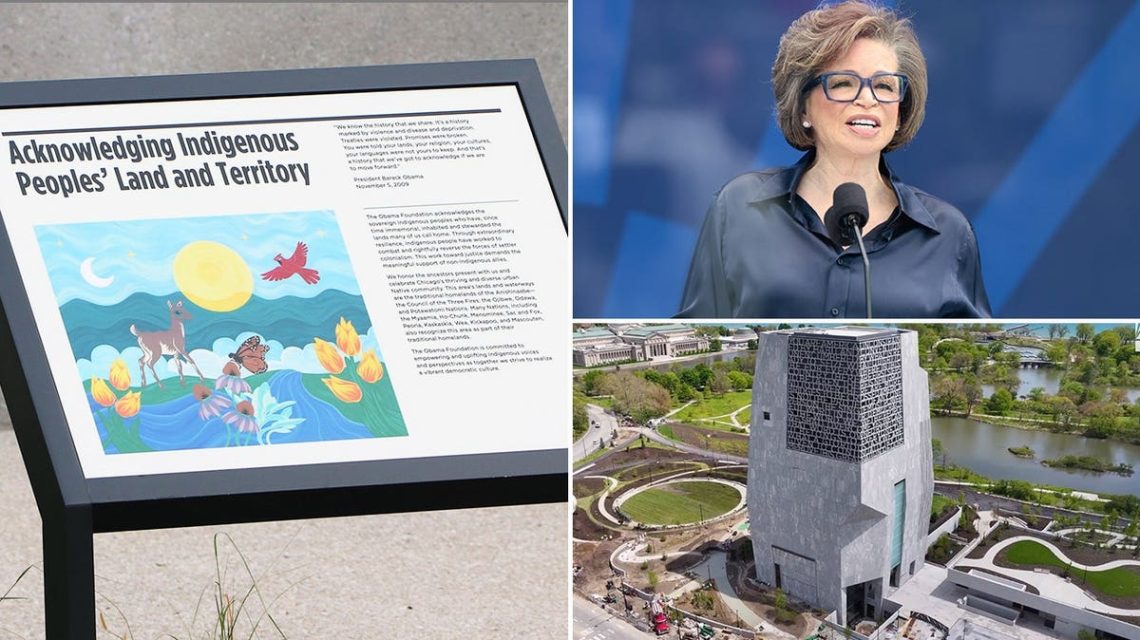
The Obama Presidential Center, recently opened in Chicago, has sparked controversy over its purpose and location. Illinois Republican Party Chairman Bob Grogan claims the center acts as a political operation for the Obama Foundation rather than a traditional library. The center’s use of public land comes under scrutiny, along with concerns about its funding and impact on local taxpayers.
Contentious Land Acknowledgement
During the center’s dedication ceremony, Obama Foundation CEO Valerie Jarrett recognized the American Indian tribes that originally inhabited the land where the center now stands. This acknowledgment extends beyond the ceremony, with a permanent display near the museum tower addressing Indigenous peoples’ connection to the land.
Critics argue that such acknowledgments, common in various institutions, often seem performative. While they serve to honor the history of Native Americans, detractors view them as reminders of contested views on America’s foundation.
Public Land Usage Controversy
The land on which the Obama Presidential Center sits was transferred from the city of Chicago to the Obama Foundation for ten dollars, under a 99-year agreement. This move has faced legal and political backlash, with critics like Grogan highlighting that the land was developed through public works projects long after Native American occupation, and thus should belong to Chicago taxpayers.
Grogan argues this site, formed after the Great Chicago Fire, should not be removed from public use without proper consideration of taxpayer interests. The center’s establishment, framed as a catalyst for local economic development, has instead raised questions about the financial implications for taxpayers.
Financial Concerns and Economic Impact
The center’s construction has reached nearly $1 billion, alongside taxpayer-funded infrastructure updates in Jackson Park. Critics point to the Obama Foundation’s unmet promise to create a $470 million endowment to shield taxpayers from future costs.
Initially promoted as beneficial for the South Side community and minority businesses, the project faces allegations from subcontractors who claim they are owed substantial sums for their work. Despite its intended positive impact, questions remain about financial management and accountability.
 Trial for Spain’s First Lady on Corruption Charges
  New Owner Discovers Skeletal Remains in Foreclosed Connecticut House
  Heat-Related Incidents Claim Lives of Hikers in Grand Canyon
  Union Dynamics in GOP Politics: An In-depth Look
  L.A. Officials Prepare for State of Emergency Amid Warehouse Fire in Boyle Heights
  Controversy Surrounds Peeling Paint of Washington’s Reflecting Pool