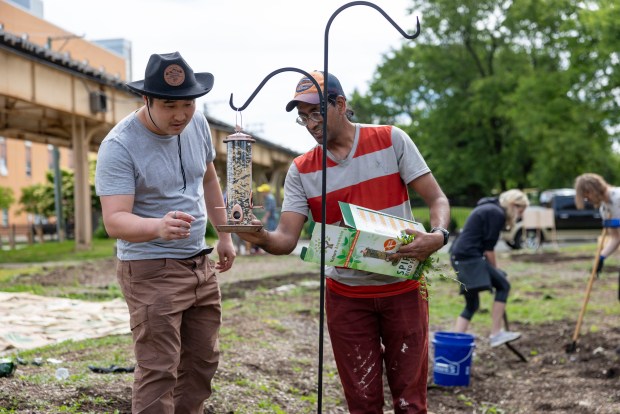
David Bippes showcased his community project on a small plot of land in Englewood to his parents, hoping to transform it. Bippes, an Eagle Scout, began his passion for community gardens during a high school service project in Missouri. He now helps lead Litter Caterpillars, a volunteer cleanup group in Chicago.
Last year, Bippes and three others purchased the vacant lot through a city auction, intending to create a neighborhood green space. “It’s like extending a childhood project,” Bippes remarked. They converted the 6,000-square-foot lot into a park with mulch, raised garden beds, and Illinois native plants like prairie grasses and yellow coneflowers. The park opened on April 12.
A week later, Bippes and his parents discovered tall piles of landscaping debris on the property. “We’re trying to reduce litter, not increase litter,” he stated. Bippes and co-founder Kevin Tao remain unsure who dumped the debris, complicating efforts to foster community trust and investment, crucial for the park’s survival.
Repeated illegal dumping poses a challenge for the park’s owners, who live outside the neighborhood. The project began when leaders acquired adjacent lots at 6316 and 6318 S. Sangamon St. for $10,000 in a citywide auction organized by Hilco, covering over 800 vacant parcels in Chicago’s South and West sides. They invested an additional $10,000 in plants and landscaping.
The plot is named Caterpillar Park, aligning with the group’s mission of transforming Chicago spaces. “Caterpillars turn into butterflies, but there’s a period where they haven’t,” Bippes said. “There’s pre-work before the amazing thing emerges.”
Tao and co-founder Rohit Agarwal recently installed a bird feeder there. Park improvements were funded by Bippes, Tao, and two other co-founders. Their group has conducted litter cleanups with over 100 volunteers city-wide over five years, aiming for a more permanent impact.
“I’m always looking for ways to improve Chicago for everyone,” Bippes shared. He aims to rally people for community betterment, especially in disinvested areas like Englewood. Tao, a Chinese immigrant’s son, sees vacant land as a healing space opportunity, inspired by changing environments to alter mindsets.
Bippes characterized their project as “duct-taped-together.” “We’re figuring out how to build a park for the first time,” he added. “None of us knows exactly what we’re doing, so we’re networking as much as possible.” All four founders hold full-time jobs apart from the project.
Organizers’ distance from Englewood creates challenges; Bippes, residing in Edgewater, takes an hour to reach the park. Urban farming groups question sustainability from afar. Litter Caterpillars alternate weekends between North Side cleanups and maintaining Englewood’s park.
Dulce Morales, co-founder of Cedillo’s Fresh Produce, an Englewood urban farm, lives close and emphasizes space’s attention needs. Despite owning two spaces, neglect leads to issues like weeds. Tao was a volunteer at Cedillo’s and seeks community advice for Caterpillar Park.
Bippes hopes the park becomes a community garden dependent on local engagement. “From the start, making it a community garden is daunting,” he said. Park sections need neighborhood volunteers.
They engage nearby residents through door-knocking and flyers to build connections. Tao notes illegal dumping complicates initial impressions, as some neighbors wrongly assumed the debris was the group’s responsibility.
Morales stresses maintaining the park’s active image to prevent neighborhood misuse or break-ins—common issues exaggerated by an abandoned appearance. Cedillo’s has seen similar challenges but improved security via community support.
Bippes is eager to resolve the dumping swiftly. He filed 311 requests and contacted the city’s Streets and Sanitation Department for debris removal and prevention. After weeks of stagnation, Tao highlighted the issue on social media. This prompted the city department to remove a large debris pile, acknowledging aggressive prosecution of illegal dumping and efforts to enhance enforcement. Ald. Stephanie Coleman, 16th, did not comment on park or dumping concerns.
Roosevelt Gordon, a former Englewood resident, supports the project if it benefits locals. He envisions the park as a teaching ground for Englewood children on farming and horticulture.
Despite setbacks, organizers remain committed. “It’s almost like a mystery,” Bippes said of the dumping. He desires to engage with dumpers, understanding their struggles and possibly involving them in Caterpillar Park’s mission.
 Ebola Outbreak in Africa: A Serious Concern
  Gold and the Ebola Outbreak in Congo’s Mining Towns
  House Passes Bill for Veterans’ Benefit Increase
  Gene Editing in Human Embryos at Columbia University
  Melinda French Gates Commits $215 Million for Global Women’s Health
  Impact of Reduced Public Health Authority Post-COVID-19