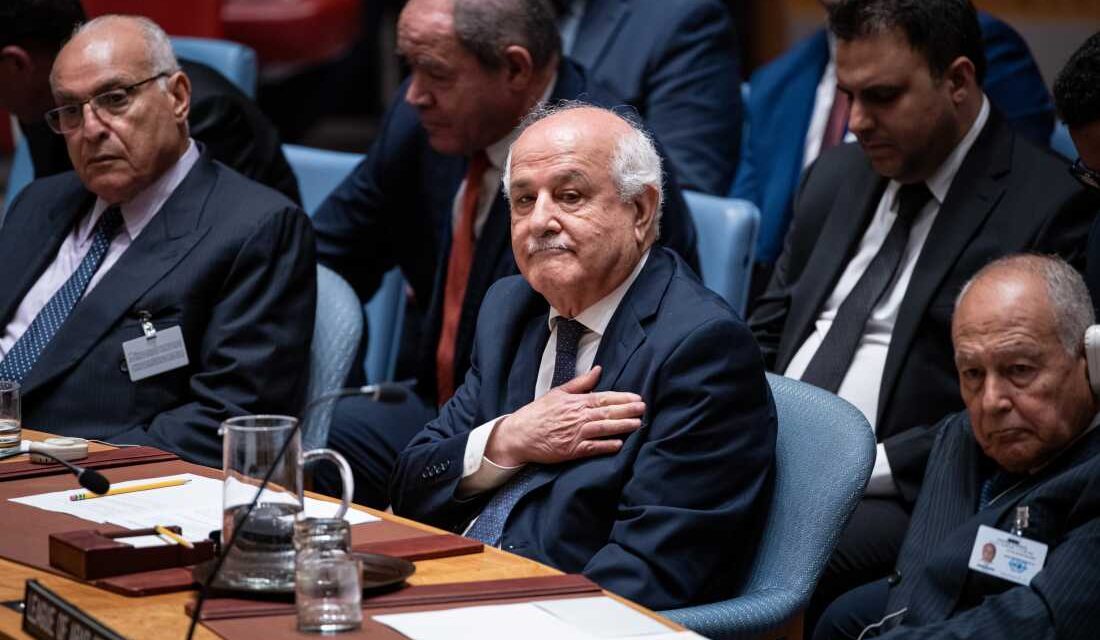
During a High-Level Security Council meeting at the 80th United Nations General Assembly session in September 2025, Palestinian Ambassador Riyad Mansour demonstrated emotional solidarity with the Kuwait crown prince. The U.S. government has issued a warning to potentially revoke the visas of Palestinian UN officials if Mansour does not withdraw his candidacy for vice president of the General Assembly.
A State Department cable, obtained by NPR, instructs U.S. diplomats to apply pressure on Palestinian representatives to withdraw their bid for vice president ahead of the voting on June 2, 2025. The U.S. believes Mansour’s past accusations against Israel increase tensions, compromising efforts to implement the peace plan for Gaza initiated by President Trump. The cable states, “A bully pulpit for Mansour would not improve the lives of Palestinians and would significantly damage U.S. relations with the PA [Palestinian Authority]. Congress will take it extremely seriously.” Despite these threats, Mahmoud Abbas’ office declined to comment.
This scenario echoes a previous action in 2024, when the Trump administration denied U.S. visas to top Palestinian officials, including President Abbas, before the U.N. General Assembly in New York. Though visas were not revoked for the delegation, the cable highlights the potential repercussions: “It would be unfortunate,” with a hint at revisiting “available options” if the bid continues.
Former U.S. diplomat, Hady Amr, argues that visa revocation in diplomatic disputes is rarely wise or effective, often used only under extreme conditions. He claims that removing diplomats hampers the ability to solve bilateral issues effectively and damages overall diplomatic efforts.
Meanwhile, the State Department’s position remains sensitive. It acknowledges obligations under the UN Headquarters Agreement but refrains from discussing specific cases due to visa record confidentiality.
Despite the possible revocation’s unprecedented nature, history shows the U.S. has previously denied visas to significant international figures due to national security concerns, such as Iranian, Russian officials, and former Palestinian leader, Yasser Arafat. Yet, a 1947 agreement prevents blocking U.N. officials from visiting New York.
In an earlier incident in February, Mansour withdrew his bid for the U.N. General Assembly presidency amidst U.S. lobbying. His candidacy sparked a critical reaction from Israel’s U.N. ambassador, who asserted that it fueled anti-Israel sentiment at the U.N., imploring the Palestinian delegation to refocus efforts on combating terrorism.
Riyad Mansour’s candidacy for vice president, part of a list with other countries such as Afghanistan, Iraq, and Mongolia, could lead to complications during high-profile sessions if a Palestinian vice president is elected. The cable expresses concern over potential future impacts on U.N. proceedings.
Throughout his tenure, Mansour has been vocal, employing emotional storytelling to highlight the humanitarian issues facing Palestinians. In May 2025, during heightened conflict in Gaza, Mansour emotionally addressed U.N. delegates, recounting the devastating losses of children in airstrikes and urging for a ceasefire to safeguard civilians.
Mansour’s passionate speeches, like those in August 2025 advocating for a ceasefire, underscore his commitment to peace. His emotional appeals serve as poignant reminders of the ongoing humanitarian crisis in the region.
NPR’s Michele Kelemen in Washington and Aya Batrawy in Dubai contributed to this report.
 Pentagon Reduces Recognized Religious Affiliations
  U.S. Military Awaits Pentagon’s Clarification on Troop Levels in Europe
  Xavier Becerra Advances in California Governor Race
  Graham Platner’s Campaign Amid Controversy
  South Carolina GOP Primary Heats Up as Trump Endorses Evette
  Potential Ebola Outbreak in Central Africa Raises Concerns of Rapid Spread