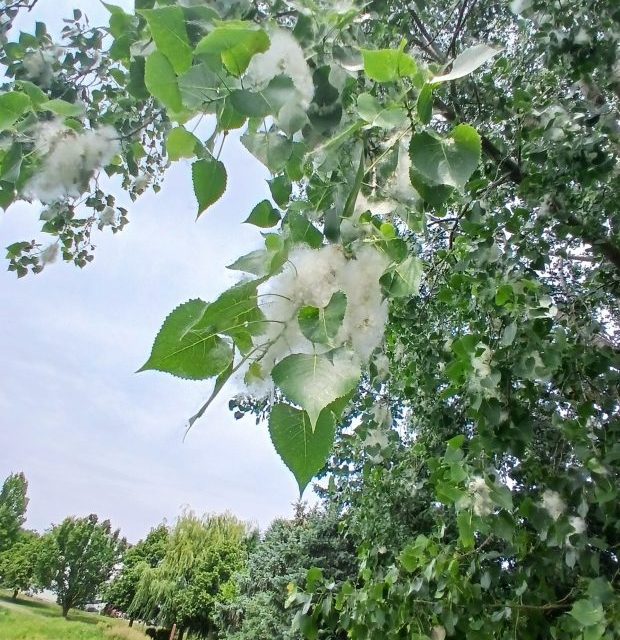
As children, we often see the world through a lens of imagination. Floating fluffs on the wind in June might seem like snow rather than the seeds of the eastern cottonwood tree. For those who find joy in watching these fluffs, it brings a sense of wonder to summer’s start.
The eastern cottonwood is a member of the poplar family. It grows rapidly, often reaching heights of 100 feet or more, and can live for over a century. These trees are identifiable by their triangular leaves, which range from 3 to 7 inches long. The largest recorded eastern cottonwood in Illinois stands at 122 feet in Ogle County and is approximately 200 years old.
In contrast, the swamp cottonwood, another species found in Illinois, remains smaller and grows primarily in the state’s southern regions. Cottonwoods thrive in moist environments, commonly found along rivers and lakes.
The cottonwood’s lifecycle includes visible transitions. Young trees have smooth, greenish-gray bark, while older trees display furrowed gray bark. Their leaves attach to branches with long stems, allowing them to flutter in the breeze. Cottonwoods begin seed production around 10 years old and reach peak seed-bearing between the ages of 30 and 40. Only female trees produce the fluffy seeds, which float thanks to white hairs called pappi, spreading them far and wide.
For many, including Bill Richmond from Palatine, the seeds symbolize the transition from school’s end to summer’s beginning in northeastern Illinois. Yet, some find them messy and blame them for sneezes, although cottonwood seed is not an allergen; other trees, like oaks, are more likely the culprits during this season.
Despite their beauty, cottonwoods can be problematic. Their large, shallow roots disrupt septic systems and underground pipes. Their limbs may break easily in severe weather, posing risks in residential areas. Some municipalities, such as Glencoe, prohibit planting them, labeling them as “lesser quality” trees.
Ecologically, cottonwoods play a role. The Lake County Forest Preserves and the Forest Preserves of Cook County manage cottonwood populations to promote diverse plant growth. Historically, Native Americans utilized the tree’s bark and roots for nutrition and ceremony. Today, the bark serves industrial and culinary purposes.
In nature, cottonwood trees are vital. Baltimore orioles, great blue herons, and bald eagles nest in them. Other wildlife, like rose-breasted grosbeaks and cedar waxwings, feed on their seeds and flowers. Beavers use the bark and leaves for sustenance, while the roots prevent streambank erosion.
Cottonwoods are integral to Illinois landscapes, lining rivers such as the Des Plaines and enriching ecosystems. They deserve appreciation alongside other native trees.
Author Sheryl DeVore has an extensive background as a reporter and nature writer. She welcomes story ideas at [email protected].
 Southeast Asia Turns to Solar Energy Amid Energy Crisis
  Trump Administration’s Offshore Wind Leasing Strategy
  African and Commonwealth Nations Push for High Seas Treaty Implementation
  Tropical Storm Arthur Forms and Threatens Gulf Coast with Heavy Rain
  Seismic Stress Reaches Millennium Highs on San Andreas and San Jacinto Faults
  Trump’s Request to Dismiss NAACP Pollution Suit Against xAI